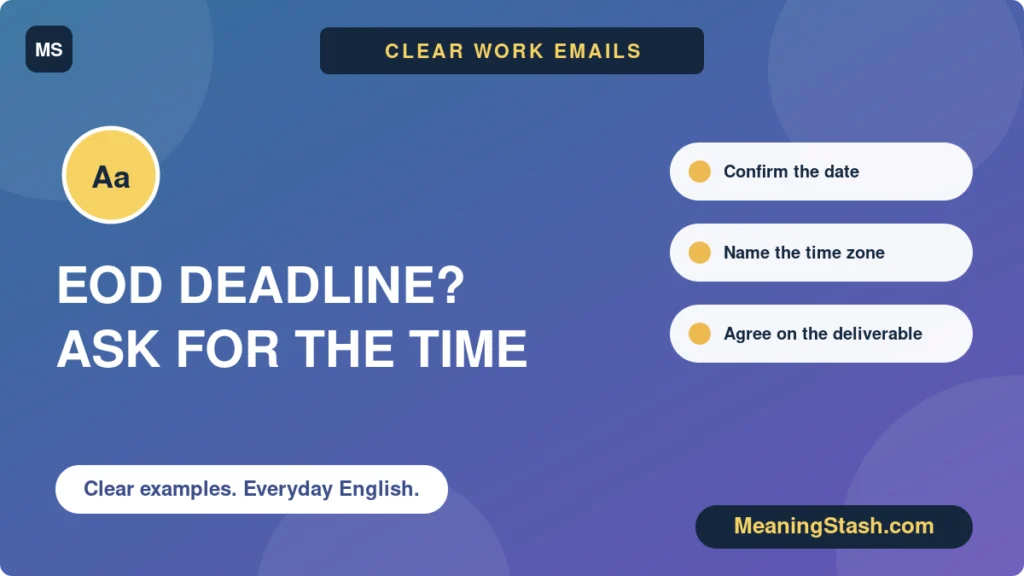
How to clarify an EOD deadline: acknowledge the request, ask for the exact date and clock time, confirm the time zone and repeat what you will deliver. A simple message is: “Thanks—I can prepare the draft. What time and time zone should I use for EOD on Friday?”
Do not assume EOD always means 5 p.m., midnight or the sender’s local time. Teams use the abbreviation differently.
How to clarify an EOD deadline in one message
Thanks for the request. To confirm, do you need the first draft or the final version? What exact time and time zone should I work to on Friday?
This asks for the two main missing details: what counts as completion and when completion is due. If the date is also unclear, ask for it explicitly.
The EOD meaning in business explains the abbreviation. Knowing its expansion, “end of day,” does not create a universal clock-time rule.
Four details to confirm
| Detail | Useful question |
|---|---|
| Date | Do you mean Friday, November 6? |
| Clock time | What exact time should I submit it? |
| Time zone | Which time zone applies? |
| Deliverable | Do you need a review draft or a finalized file? |
Use example dates only as placeholders for your situation. If a legal, contractual or system deadline applies, follow its stated rules rather than an informal interpretation of EOD.
Email examples for common situations
Same-office team: “I’ve received this. Does EOD mean 4:30 p.m. today for this task? I’ll send the completed spreadsheet once confirmed.”
Different locations: “Happy to prepare it. Please confirm the deadline date, time and time zone so I can schedule the review.”
Unclear stage: “For EOD tomorrow, would you like an initial draft for comments or the final approved version?”
Several priorities: “I can finish either the report or the slides by the confirmed deadline. Which should take priority?”
How to propose a precise deadline
You can suggest a time without presenting it as the existing agreement: “Would 3 p.m. UTC on November 6 work for the review draft?” Wait for confirmation if the deadline is consequential.
When converting between local times, check the actual date and daylight-saving rules. Do not convert from a city’s usual offset without checking the relevant day. A full date and zone name reduce confusion.
If you cannot meet the deadline
Say so early, explain the practical constraint briefly and offer a specific alternative. “I can send the data table by 2 p.m. and the commentary by 11 a.m. tomorrow. Would that meet your needs?” is more useful than a vague promise to try.
If your absence affects delivery, communicate it directly and make sure your out-of-office message does not contradict the arrangement. Do not assume an automatic reply transfers responsibility to another person.
Wording that sounds cooperative
“To confirm,” “so I can schedule the work,” and “which version do you need?” explain why you are asking. Avoid an accusatory tone such as “Your deadline makes no sense.” The meaning of deadline concerns a completion limit; clarity about that limit helps both sides.
Related timing expressions such as toward and towards can be approximate in ordinary language. A deadline should be more exact than “toward the end of the afternoon.”
Frequently asked questions
Is it unprofessional to ask what EOD means?
No. A short clarification can prevent missed expectations, especially across locations or teams.
Can I assume midnight if no one replies?
There is no universally safe assumption. Follow an existing documented policy or escalate the unclear timing through your normal work process.
Should I confirm COB the same way?
Yes, when its practical time or time zone is unclear. Do not assume the abbreviation supplies those details.
What should the confirmation include?
The date, exact time, time zone and deliverable stage, together with any agreed dependencies.