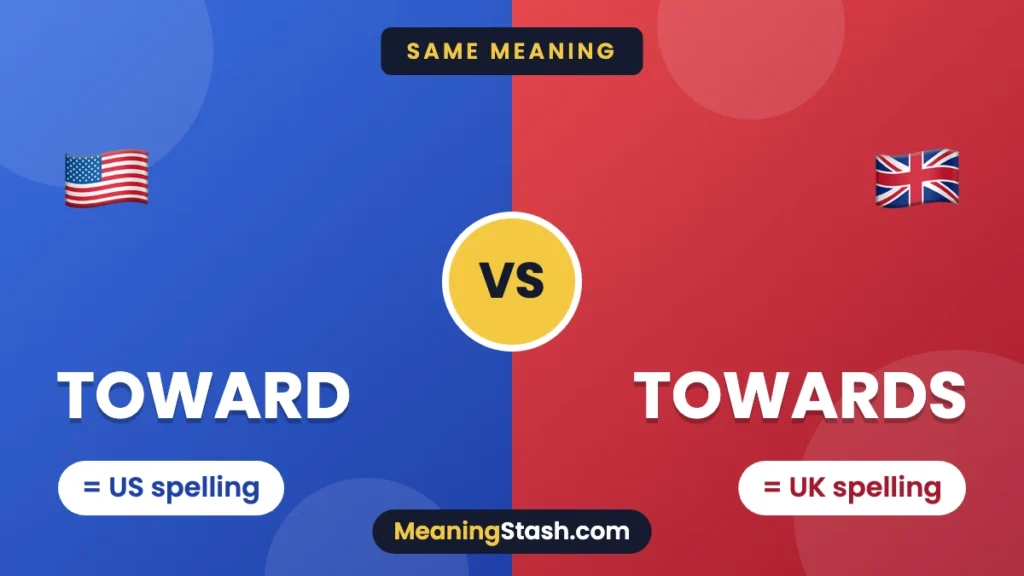
Toward and towards mean the same thing. Both are standard English. Toward is more common in American English, while towards is more common in British English. Choose the form your audience or style guide prefers, then use it consistently.
Neither form changes the direction, attitude or purpose described in a sentence. Adding the final s does not make the word plural, more formal or more polite.
Toward vs towards at a glance
| Question | Toward | Towards |
|---|---|---|
| Is it correct? | Yes | Yes |
| Common preference | American English | British English |
| Meaning | In a direction, in relation to, or as a contribution | The same |
| Example | We walked toward the station. | We walked towards the station. |
How to choose between toward and towards
For a US publication, toward is usually the straightforward choice. For a British publication, towards will often look more familiar. If your school, employer or publisher supplies a style guide, follow it.
For an international audience with no house style, either form works. Consistency is a useful editing habit, but an occasional change of form does not turn a grammatical sentence into an incorrect one. Regional preferences are tendencies, not rules about what every speaker must say.
The spelling choice works much like gray vs grey: the audience’s usual variety of English matters more than a supposed difference in meaning.
Examples of the main meanings
Movement in a direction
“The bus moved toward the bridge.” You can replace toward with towards without changing where the bus went.
An attitude or relationship
“Her attitude towards the proposal changed.” Here the word means “in relation to,” rather than physical movement.
A contribution or purpose
“I put the refund toward a new laptop.” The refund pays part of the cost. The sentence does not say that it covers the whole price.
An approximate time
“The office gets quieter towards the end of the day.” This describes a period near the end, not a precise deadline. A work request using EOD, or end of day, may need an exact time instead.
Common mistakes to avoid
- Calling towards a typo: it is a standard form.
- Treating the final s as a plural: neither form is a plural noun in these examples.
- Replacing every word ending in -ward: related words have their own uses. For example, a forward pass does not become a forwards pass.
- Confusing spelling with grammar: changing toward to towards cannot repair unclear word order elsewhere in a sentence.
The dictionary entry for toward can help when you want to check an unfamiliar sense. Our spelling comparisons cover other choices that depend on meaning or regional usage.
Frequently asked questions
Is towards wrong in American English?
No. Toward is the more common American preference, but towards is also standard English.
Is toward acceptable in British English?
Yes. Towards is more common, but toward is not inherently incorrect.
Should I write toward or towards in an essay?
Follow the variety of English and style requirements used by your course. If none is specified, choose one and stay consistent.
Do toward and towards have different meanings?
No. In ordinary prepositional uses, they are interchangeable.