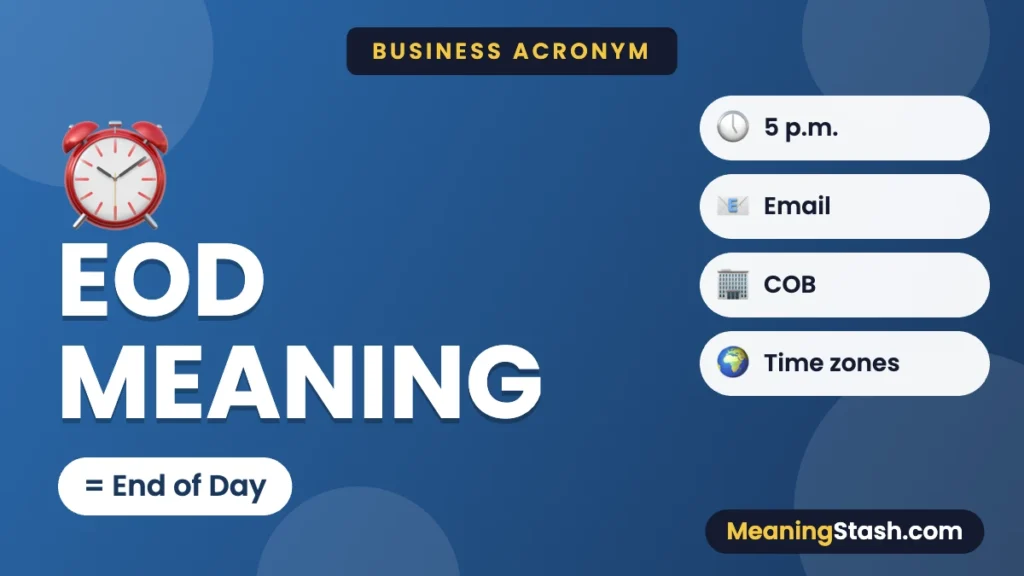
EOD means “end of day.” In a work message it usually refers to the end of an agreed working day, but it does not identify one universal time. Do not assume it automatically means 5 p.m., midnight or the sender’s time zone.
If a deadline matters, replace the abbreviation with a date, time and time zone. “Please send the draft by 16:00 UTC on 12 May” is clearer than “Send it by EOD.”
EOD meaning in a work deadline
| Message | What it tells you | What may still be unclear |
|---|---|---|
| “By EOD” | A day-ending deadline is intended. | The date, time and time zone |
| “By EOD Friday” | Friday is the intended day. | The exact time and whose working day |
| “By 16:00 UTC on 12 May” | A specific instant is named. | Usually much less, provided everyone understands the date |
Does EOD mean 5 p.m. or midnight?
It can mean different things in different teams. An office may treat it as closing time. A colleague may mean before they finish their shift. A process with a written definition may use a particular calendar-day cutoff.
The abbreviation itself does not settle that choice. A person working an evening shift and a person working a standard daytime schedule can have different ends to their working days.
When an organization has a documented deadline rule, use that rule. When it does not, ask rather than turning a familiar office habit into a universal definition.
EOD vs COB, EOB and EOW
| Term | Expansion | Practical point |
|---|---|---|
| EOD | End of day | Clarify which day and cutoff. |
| COB | Close of business | Often points to business closing time, which still needs a location or rule. |
| EOB | End of business | Can be used similarly to COB. |
| EOW | End of week | The workweek and closing time may differ. |
| ASAP | As soon as possible | Expresses urgency, not a specific deadline. |
A deadline is the latest agreed time for something to happen. An abbreviation is useful only if both sides understand the same limit.
Clear ways to ask and reply
- Ask for clarification: “When you say EOD, what time and time zone should I use?”
- Confirm your understanding: “I can send it by 4 p.m. your time tomorrow. Does that meet the deadline?”
- Set the deadline: “Please send the final file by 16:00 UTC on 12 May.”
- Flag a problem: “I can finish the first section today; the complete version will be ready tomorrow at 10 a.m. UTC.”
These examples describe the task and availability directly. They avoid an agreement that only looks clear because everyone recognizes the letters EOD.
Time zones and absence
“Local time” is ambiguous in a remote team. Name a time zone or agreed reference such as UTC. If you convert it, account for daylight-saving changes rather than assuming that every location keeps the same offset throughout the year.
An OOO message, meaning out of office, can explain why someone will not respond before a cutoff. Arrange the handover and backup contact before relying on an automatic reply.
Other contexts
In another setting EOD can stand for something different, such as explosive ordnance disposal. A specialist document should define its abbreviation. This page explains workplace shorthand, not every technical use of the same letters.
Frequently asked questions
Is EOD always 5 p.m.?
No. That is a common office interpretation, not a universal definition. Confirm the actual cutoff.
Whose time zone does EOD use?
The abbreviation alone does not specify one. Use an agreed team rule or ask the sender to name the time zone.
Is EOD the same as COB?
They can overlap, but COB emphasizes business closing time. Both can remain unclear without an exact cutoff.
Is it better to spell out end of day?
Spelling it out helps readers unfamiliar with the abbreviation, but an important deadline still needs a date, time and time zone.