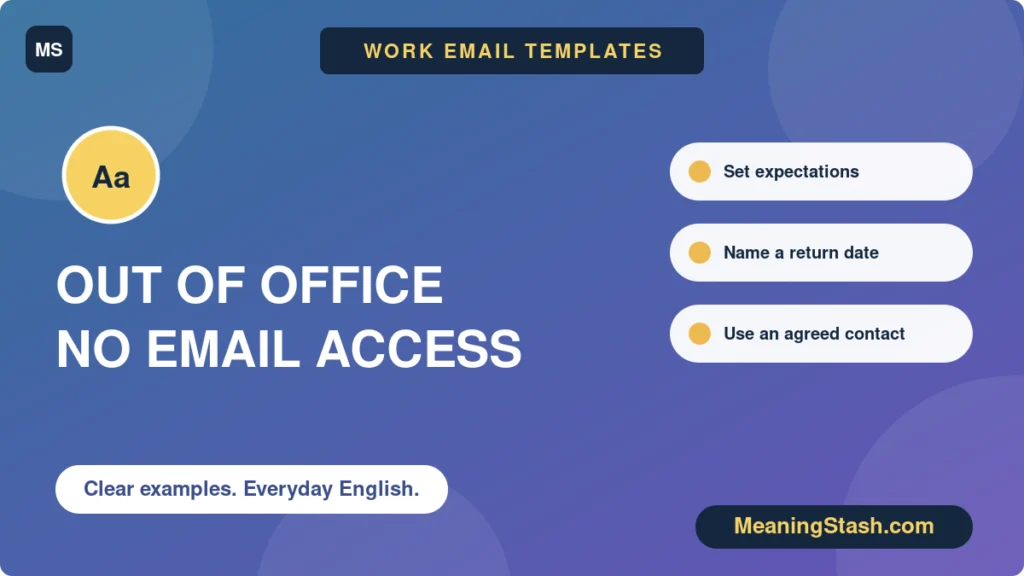
An out of office message with no email access should say when you are unavailable, when you expect to return and what the sender can do if the matter is urgent. Keep it brief and do not promise immediate replies on your return unless that is realistic.
Use the templates below as starting points. Replace every bracketed field and get permission before listing another person as your backup.
Out of office message with no email access: basic template
Subject: Out of office until [return date]
Thank you for your message. I am out of the office with no access to email until [return date]. I will respond after I return. For urgent matters during my absence, please contact [agreed contact name or team] at [approved contact details].
If no backup is available, remove that line rather than inventing one. State any realistic alternative, such as a shared support address already approved by your organization.
Template for a short absence
Thank you for your email. I am unavailable on [date] and will not be checking messages. I expect to return on [date] and will reply after that. If your request cannot wait, please use [approved contact route].
One clearly stated date may be enough for a one-day absence. Include the year or spell out the month when a numeric date could be interpreted differently by an international reader.
Template for an extended absence
I am away from work from [start date] through [last day away] with no access to email. I expect to return on [return date]. During this period, [team or agreed colleague] is handling [specific type of request] through [approved contact route]. Please send urgent requests there. I will review other messages after my return.
This makes the backup’s scope explicit. It does not imply that the colleague has agreed to handle every possible request.
No email access vs limited email access
| Your actual situation | Clear wording |
|---|---|
| You will not read messages. | I will not be checking email during this period. |
| You may read messages occasionally. | I will have limited email access, so replies may be delayed. |
| You are away but working normally. | Describe the real availability rather than using a misleading no-access message. |
The OOO meaning in email describes being out of office, which does not automatically mean being offline. Choose the wording that accurately reflects your availability.
What to leave out
- Private travel plans, addresses or unnecessary personal details.
- A colleague’s private phone number without approval.
- Promises of instant replies when you return.
- Confidential project details in a reply that unfamiliar senders may receive.
- Instructions that conflict with your organization’s contact policy.
You generally do not need to explain why you are away. A return date and a usable contact route are more helpful than a detailed personal account.
Check deadlines before switching the reply on
An auto-reply does not resolve work already agreed with someone. Confirm any EOD deadlines and handovers directly before leaving. Check the reply’s start and stop settings in your email service and send a test if your normal process allows it.
For precise wording, compare alternatives to unavailable. “Unreachable” may be too strong if an approved backup channel remains open.
Frequently asked questions
Should I say I have no access if I may check email?
Use limited access or say replies may be delayed. Accurate wording avoids false expectations.
Must I name a backup contact?
No. Include one only when a suitable person or team has agreed to that role.
Does until Monday mean I return Monday?
Readers can interpret it differently. “I return on Monday, [date]” is clearer.
Should I include my holiday destination?
It is usually unnecessary. Keep the message focused on availability and approved contact options.