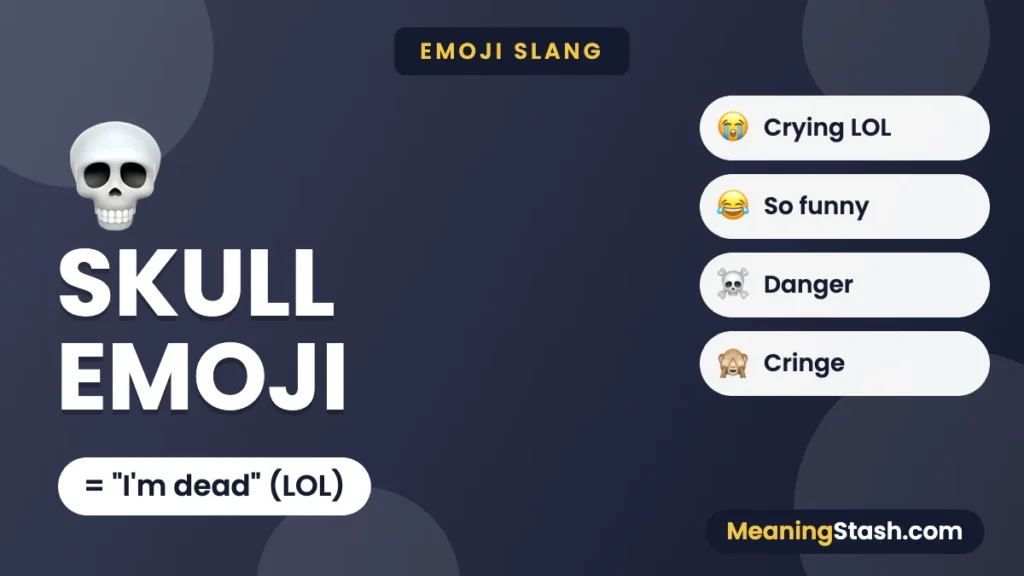
The 💀 skull emoji meaning in casual texts is often “I’m dead laughing,” “that’s too funny” or “I can’t handle this.” The 💀 Skull symbol can also express embarrassment, shock or disbelief. In other contexts, it keeps its literal connection to death, danger or spooky imagery.
“That joke 💀 Skull” is probably a laughter reaction. A 💀 skull beside a Halloween costume is likely decorative. Serious words about harm or loss should be read seriously rather than dismissed as internet slang.
💀 Skull emoji meaning in common messages
| Message | Likely reading |
|---|---|
| “The way he walked away 💀 Skull” | Something was extremely funny. |
| “I called my teacher Mum 💀 Skull” | Embarrassment or cringe. |
| “They charged that much? 💀 Skull” | Shock or disbelief. |
| “Finished my Halloween makeup 💀 Skull” | A spooky or literal 💀 skull theme. |
Why a 💀 skull can mean laughter
Expressions such as “I’m dying laughing” and “that killed me” exaggerate how funny something feels. The 💀 skull can act as a compact visual version of that exaggeration. It usually does not mean actual death in an obviously playful exchange.
That reading depends on context. Not everyone uses the same internet conventions, and no age group uses emoji in one uniform way. Avoid assuming that the symbol is a joke when the accompanying words describe a serious event.
Is 💀 Skull rude or insulting?
It can be friendly laughter at a shared joke, but it can also make a vulnerable message feel mocked. “I failed my exam 💀 Skull” may be self-directed humor. Replying with only a 💀 skull to someone who is upset could sound dismissive.
Ask what you are reacting to: the joke, the awkward situation or the person. A short sentence such as “That situation sounds awkward” is less ambiguous than a symbol alone.
How to reply to a 💀 skull emoji
- A shared joke: “That timing was incredible.”
- An embarrassing story: “I would have gone quiet too.”
- A surprise: “I know—I wasn’t expecting that either.”
- An unclear reaction: “Are you laughing at the joke, or did something happen?”
In a serious conversation, respond to the actual issue. You do not need to copy the sender’s emoji to show you understood.
💀 Skull, ☠️ skull and crossbones, and other reactions
💀 Skull and ☠️ skull and crossbones are separate emoji. Crossbones can emphasize danger, pirates, poison imagery or a spooky theme; it can also be used jokingly. Neither symbol replaces official safety instructions or labeling.
The 🫠 melting face emoji often adds awkwardness or overwhelmed irony. The 🥹 face holding back tears more often emphasizes being emotionally moved. In slang-heavy chats, FR meaning “for real” may reinforce agreement while a 💀 skull supplies the laughter reaction.
Using the 💀 skull emoji clearly
Write “💀 skull emoji” beside 💀 Skull in explanations, especially for readers unfamiliar with the symbol. For formal messages or sensitive topics, use plain words. “That was funny” or “That surprised me” communicates the exact reaction.
Frequently asked questions
Does 💀 Skull mean laughing?
Often in casual internet chat, yes. It commonly works like “I’m dead laughing,” but it is not limited to that use.
Does a 💀 skull emoji always mean death?
No. It can be figurative laughter or embarrassment, as well as literal or decorative 💀 skull imagery.
What do several 💀 skull emoji mean?
Repeating the symbol often intensifies the reaction. It does not create a separate universal definition.
Is 💀 Skull the same as ☠️ Skull and Crossbones?
No. One shows a 💀 skull and the other a 💀 skull with crossbones. Their uses can overlap, so read the surrounding message.