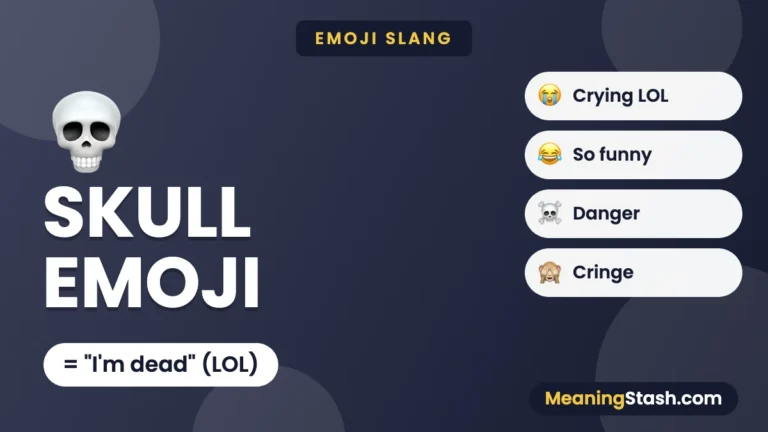
💀 Skull emoji vs 😭 crying emoji for laughing compares two exaggerated reactions used in some casual chats. The 💀 skull can mean “I’m dead laughing.” The 😭 loudly crying face can mean “I’m crying with laughter.” Both also have serious or literal uses, so the surrounding message matters.
Neither symbol is a universal laughter code. A message about grief, danger or real distress should not be dismissed as a joke because one of these emoji appears.
💀 Skull emoji vs 😭 crying emoji for laughing at a glance
| Emoji and name | A possible laughter reading | Other possible uses |
|---|---|---|
| 💀 Skull | “That killed me” or extreme amusement. | Embarrassment, shock, spooky imagery or literal death-related context. |
| 😭 Loudly crying face | “I’m crying laughing.” | Sadness, disappointment or intense emotion. |
| 😂 Face with tears of joy | A more explicitly laughter-related design. | It can still sound mocking in the wrong conversation. |
When the 💀 skull is a laughter reaction
After an obviously funny clip, “The timing 💀 Skull” can indicate that the viewer found it extremely funny. The 💀 skull emoji meaning also includes embarrassment and disbelief, so not every 💀 skull is laughter.
“I said the wrong name in the meeting 💀 Skull” may emphasize cringe rather than enjoyment. If you reply, acknowledge the awkward situation rather than assuming the sender wants to be laughed at.
When 😭 loudly crying face means laughter
“I can’t stop laughing 😭 Loudly Crying Face” states the intended reaction clearly. In “This video 😭 Loudly Crying Face,” the clip and prior conversation supply the context. Without that context, the same face could indicate sadness or another strong feeling.
Do not create a rigid scale in which one symbol always means a stronger laugh. People differ in how they use and repeat emoji.
Three messages with different tones
“That impression was perfect 💀 Skull 😭 Loudly Crying Face”: in a shared joke, the combination may emphasize amusement.
“I missed the last bus 😭 Loudly Crying Face”: disappointment is more likely than laughter unless the surrounding exchange makes a joke clear.
“We’re remembering him today 💀 Skull”: the words introduce a serious topic. Do not automatically apply the “dead laughing” interpretation.
How to reply without sounding dismissive
- A clear joke: Respond to the funny detail.
- An embarrassing event: “That sounds awkward. Did it work out?”
- A real setback: “That’s frustrating. Is there another option?”
- An unclear emotional reaction: “Are you laughing, or did something upset you?”
The 🫠 melting face emoji can also mark awkwardness or overwhelm. The 🥹 face holding back tears often signals being emotionally moved. Choose a response based on the event rather than a guessed emoji hierarchy.
Age and platform do not settle every meaning
You may encounter claims that one generation uses only skulls and another uses only laughing faces. Those are oversimplifications. People learn habits from friends, communities and platforms, and individuals use symbols differently.
If you are explaining an emoji to a reader, include its readable name. “The 😭 loudly crying face” distinguishes 😭 Loudly Crying Face from the 😢 crying face and the 😂 face with tears of joy.
When to use plain words
For sensitive feedback or serious news, “That made me laugh,” “I’m sorry that happened” or “I’m upset about this” is clearer. The synonyms for amused can help describe your reaction, but avoid a synonym that changes its intensity or meaning.
Frequently asked questions
Can 😭 loudly crying face mean laughing?
Yes, in some casual conversations. The same emoji can also express genuine sadness or intense emotion.
Is 💀 skull always funnier than 😢 crying face?
No. There is no universal ranking of laughter intensity.
Can I combine 💀 skull and 😭 loudly crying face?
Yes, if the context is clearly playful, but combining them does not create one fixed meaning.
Should I assume a serious message is a joke if it has a 💀 skull?
No. Read the words and situation carefully, and ask for clarification when needed.