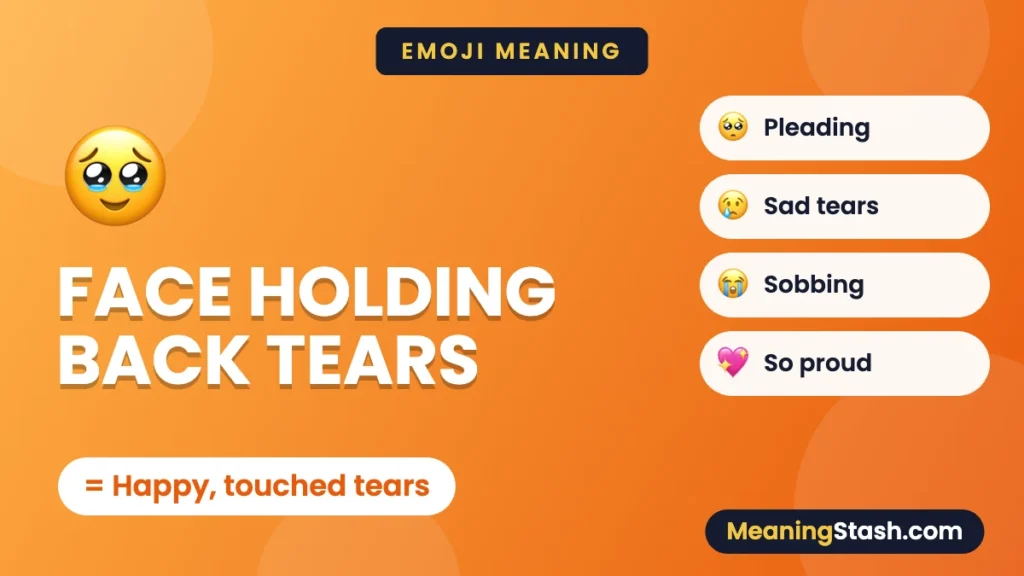
The 🥹 face holding back tears meaning is an emotional reaction: feeling touched, grateful, proud, relieved or sad. The 🥹 Face Holding Back Tears emoji looks as though tears are gathering while the face tries to keep them back. The surrounding words tell you which emotion fits.
“You remembered my birthday 🥹 Face Holding Back Tears” usually expresses being moved. “I wish you could stay 🥹 Face Holding Back Tears” is more likely to show sadness. Neither meaning applies automatically to every message.
🥹 Face holding back tears meaning in common messages
| Message | Possible meaning |
|---|---|
| “You saved me a seat 🥹 Face Holding Back Tears” | Gratitude for a thoughtful gesture. |
| “My little sister graduated 🥹 Face Holding Back Tears” | Pride and emotion. |
| “We finally got the keys 🥹 Face Holding Back Tears” | Relief or joyful disbelief. |
| “I’ll miss this place 🥹 Face Holding Back Tears” | Sadness or nostalgia. |
| “Look at that tiny puppy 🥹 Face Holding Back Tears” | Affection or being overwhelmed by cuteness. |
Is the 🥹 Face Holding Back Tears emoji happy or sad?
It can be either, and sometimes both. A farewell can feel happy because someone is starting a good opportunity and sad because they are leaving. The emoji can convey that mixture without naming it precisely.
Do not treat the symbol as a diagnosis or a measure of how much someone is crying. Online expressions are often exaggerated for warmth or humor.
How it differs from similar faces
- 🥺 Pleading face: often accompanies a request, an appeal or a vulnerable expression.
- 🥹 Face holding back tears: often reacts to something emotionally moving.
- 😢 Crying face: commonly signals sadness or hurt.
- 😭 Loudly crying face: can express distress, exaggerated emotion or laughter in casual chat.
Those uses overlap. A 🥺 pleading face beside 👉👈 pointing fingers together may make a request feel shy, while the 🥹 face holding back tears may thank someone after they agree.
What to reply to 🥹 Face Holding Back Tears
Answer the situation rather than guessing the emotion from the face alone. If a friend thanks you, “You’re welcome—I’m glad it helped” fits. If they share an achievement, “You worked hard for this. Congratulations!” acknowledges it.
When the message sounds sad, try “That sounds difficult. Want to talk?” If it is unclear, ask “Happy tears or sad tears?” in a tone that suits your relationship.
Does it mean someone likes you?
It may show warmth, but warmth is not automatically romantic. Friends, family and colleagues can all feel grateful or moved. Look at what the sender says and how they normally communicate.
Adding the 🫶 heart hands emoji can reinforce appreciation. A 🤍 white heart can add support. These combinations still do not prove a particular relationship intention.
Using the emoji clearly
Pair it with a short sentence: “That was so thoughtful 🥹 Face Holding Back Tears” or “I’m proud of you 🥹 Face Holding Back Tears.” The words make the message easier to understand for someone unfamiliar with the symbol or viewing a different design.
Frequently asked questions
What is the name of 🥹 Face Holding Back Tears?
Its name is 🥹 face holding back tears. Include that readable name when explaining the symbol.
Does 🥹 Face Holding Back Tears always mean happy tears?
No. Gratitude and joy are common uses, but sadness, nostalgia and mixed feelings also fit.
Is 🥹 Face Holding Back Tears the same as 🥺 Pleading Face?
No. They are separate emoji. 🥺 Pleading face often supports an appeal, while 🥹 face holding back tears often shows being emotionally moved.
Does the sender’s gender change its meaning?
There is no reliable gender-based rule. The conversation and the individual’s habits are more useful clues.