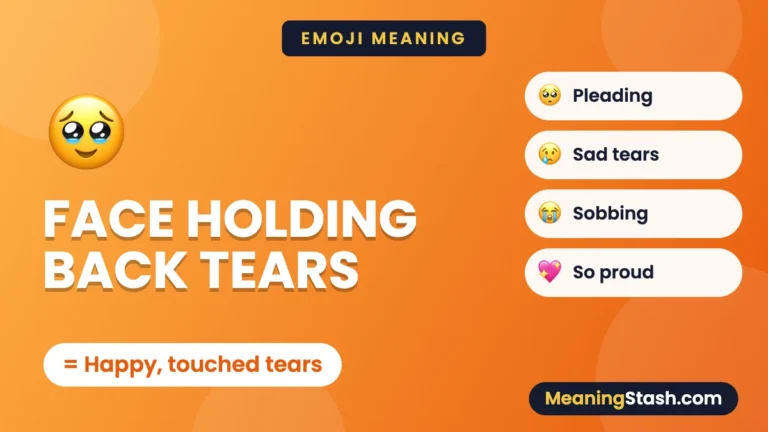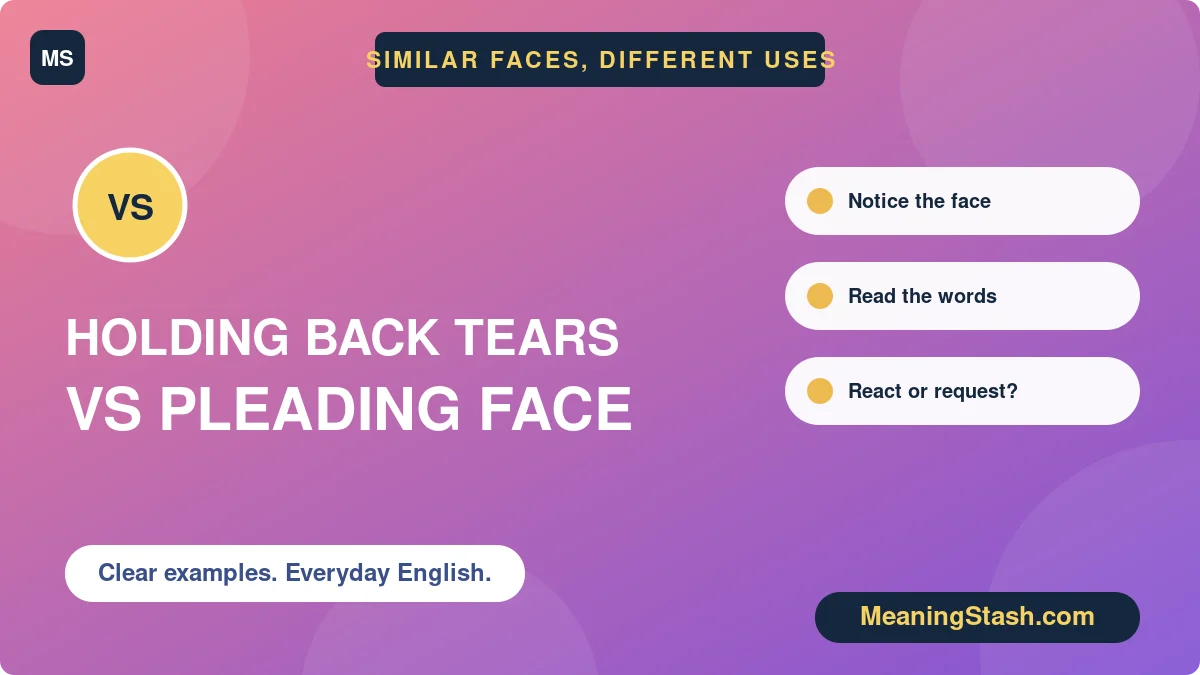
🥹 Holding back tears vs 🥺 pleading face emoji compares 🥹 Face Holding Back Tears, often used for an emotional reaction, with 🥺 Pleading Face, often used for pleading, vulnerability or an imploring request. Both can look tender or teary, and their uses overlap. The sentence is more reliable than the face alone.
“You remembered my favorite snack 🥹 Face Holding Back Tears” commonly expresses being touched. “Could you save me a snack? 🥺 Pleading Face” commonly asks for something in a pleading tone.
🥹 Holding back tears vs 🥺 pleading face emoji at a glance
| Emoji and name | Common conversational role | Example |
|---|---|---|
| 🥹 Face holding back tears | Reacting with gratitude, pride, sadness or mixed emotion. | “I’m so proud of you 🥹 Face Holding Back Tears” |
| 🥺 Pleading face | Asking, appealing or showing vulnerability. | “Can you stay a little longer? 🥺 Pleading Face” |
These are common patterns, not strict grammar rules. People may choose either face because it matches their personal texting style.
Visual clues that help identify them
The 🥹 face holding back tears typically shows gathered tears and a restrained emotional expression. The 🥺 pleading face typically has large, upward-looking eyes and an imploring expression. Designs vary across devices, so small details may not look identical.
When explaining a message, use the readable names. “The 🥹 face holding back tears” is clearer than saying “the watery-eyes one” when both symbols can appear watery-eyed.
Reaction vs request: a useful first test
If the sentence thanks someone or responds to a meaningful moment, the 🥹 face holding back tears meaning may fit naturally. If the sentence asks for a favor, 🥺 pleading face may reinforce the appeal.
But a request can also be emotional, and a reaction can be imploring. “Please don’t leave 🥹 Face Holding Back Tears” combines both. Avoid turning the reaction/request distinction into an absolute rule.
Happy, sad or both?
Neither face is limited to one emotion. Graduation can bring pride and sadness at a farewell. A 🥺 pleading face can be playful, genuinely upset or deliberately exaggerated for a joke.
Do not infer the seriousness of someone’s distress from the emoji alone. Read what happened and respond to their words. “Do you want to talk about it?” may be more helpful than guessing whether the tears are happy.
How to reply without misreading the tone
- Gratitude: “You’re welcome. I’m glad it helped.”
- Pride or achievement: “Congratulations—you worked hard for this.”
- A favor: Say whether you can help and when.
- Unclear sadness: “What happened? I’m listening.”
The 👉👈 pointing fingers together combination can make a request look especially shy. You can still decline politely; affectionate-looking symbols do not create an obligation.
Useful wording for the feeling
Words such as “touched,” “grateful,” “moved” and “pleading” describe different aspects of the message. The emotional sense of moved and related words can help, provided you avoid confusing emotional movement with physical motion.
The 🫶 heart hands emoji can accompany thanks or support without showing a teary face. Adding it does not confirm romance or a new hidden meaning.
Frequently asked questions
Are 🥹 face holding back tears and 🥺 pleading face the same emoji?
No. They are separate characters with different names and designs.
Is 🥹 face holding back tears always positive?
No. It can express sadness, nostalgia or mixed emotion as well as gratitude and joy.
Is 🥺 pleading face always asking for something?
No. Pleading is a common use, but vulnerability, affection and playful reactions also occur.
Does either face prove romantic interest?
No. Friends, family and colleagues can all use emotional or appreciative emoji.