How to reply to 👉👈 pointing fingers emoji starts with the words around the 👉👈 Pointing Fingers Together gesture. Answer a favor directly, respond to an invitation honestly and ask for clarification if the sender has given you only symbols. “Sure, I can help after lunch” is often more useful than another ambiguous emoji.
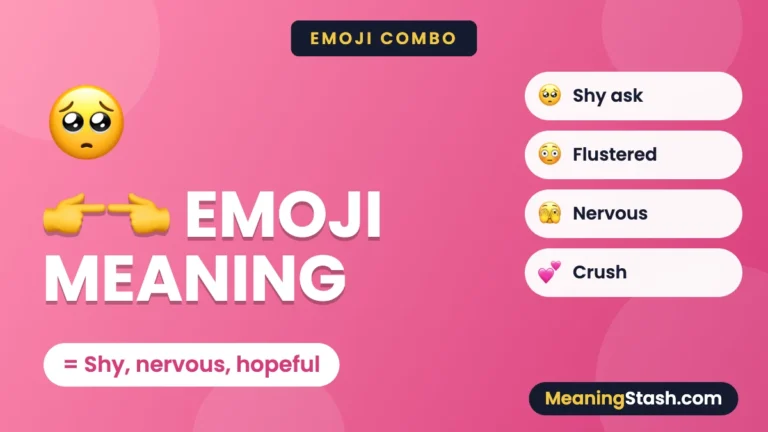
The combination can make a message look shy, sheepish or playful. It can accompany flirting, but it does not prove romantic intent.
How to reply to 👉👈 pointing fingers emoji: quick examples
| Their message | What to answer | Possible reply |
|---|---|---|
| “Can I borrow your notes? 👉👈 Pointing Fingers Together” | The request. | “Sure. I can send them tonight.” |
| “Want coffee sometime? 👉👈 Pointing Fingers Together” | The invitation. | “Yes, Saturday afternoon works.” |
| “I took the last biscuit 👉👈 Pointing Fingers Together” | The admission or joke. | “Save me one next time!” |
| Only 👉👈 Pointing Fingers Together | The missing context. | “What would you like to ask?” |
Understand the gesture before matching it
The 👉👈 pointing fingers together meaning usually involves shyness or hesitation. Two separate pointing-hand emoji form the combination. It is not a single official symbol with a fixed reply.
You do not need to mirror it. A direct sentence can be friendly and clear, especially if the sender is nervous about asking something practical.
Replying to a favor
If you can help, say what you can do and when: “I can explain question three after class.” If you cannot, say so kindly: “I can’t lend my laptop, but you can use the library computers.”
A hesitant-looking emoji does not create an obligation. Avoid agreeing to something you do not want or cannot realistically provide just because the request seems cute.
Replying to a possible date
Respond to the invitation rather than deciding the entire relationship from the symbol. “I’d like that. Do you mean as a date?” is appropriate when the distinction matters.
If you are not interested romantically, a clear boundary is kinder than a misleading reply: “I’d be happy to meet as friends.” The sender’s gender does not supply a separate hidden definition for the gesture.
Replying to a sheepish joke
When the situation is light, a small joke can work: “The biscuit committee will hear about this.” But first consider whether the admission affects you seriously. If someone has broken an agreement, address the action plainly rather than letting an emoji erase it.
For a genuinely awkward misunderstanding, “No worries—thanks for explaining” may be enough. Do not promise that something is fine when it needs a real conversation.
When other emoji are added
A 🥺 pleading face can make a request more imploring. The 🥹 face holding back tears more often adds an emotional reaction. The 🫶 heart hands emoji can add affection or thanks. None of these combinations changes the need to understand the sentence.
If you are searching for a precise word for the tone, compare synonyms for bashful. “Embarrassed,” “hesitant” and “shy” overlap but do not describe every situation equally well.
Frequently asked questions
Should I send 👉👈 pointing fingers emoji back?
Only if it suits your style. You can answer naturally without copying the emoji.
Is the shy finger gesture always flirting?
No. It can accompany favors, jokes and awkward admissions as well as flirtation.
What if someone sends only pointing fingers?
Ask what they mean or what they want to ask. There is not enough context to decode a specific request.
Can I say no to a request with a pleading emoji?
Yes. A polite, direct boundary is appropriate even when a request is framed playfully.