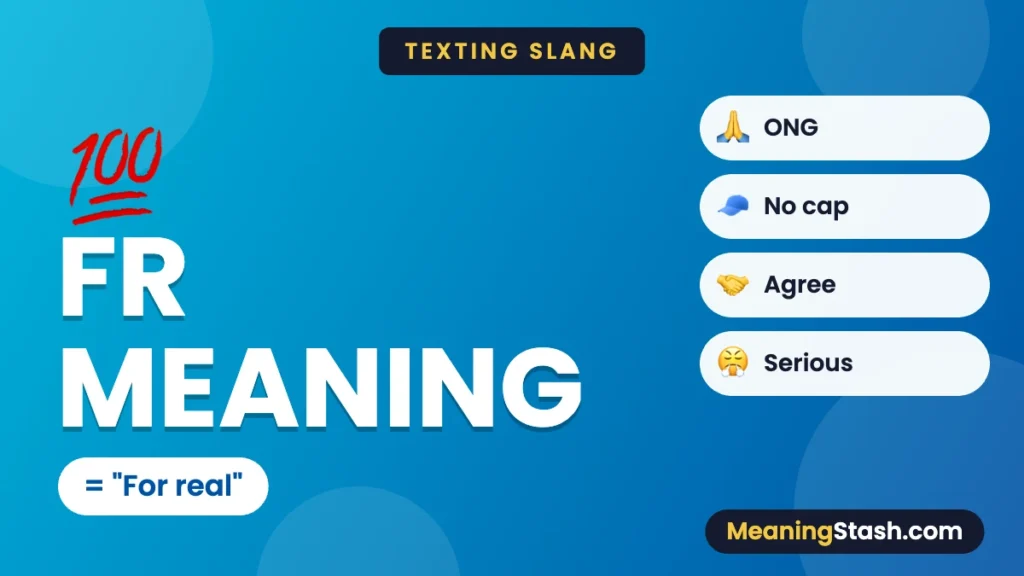
FR means “for real” in casual texting. It can show agreement, emphasize that someone is serious, or ask “Really?” The punctuation and position of the abbreviation help you choose the right reading.
“That was tiring fr” means “That was seriously tiring.” A reply of “fr” usually agrees. A message saying “fr?” asks whether something is true.
FR meaning in text: common forms
| Form | Likely reading | Example |
|---|---|---|
| fr | Seriously; I agree | “The queue was long fr.” |
| fr? | Really? Are you serious? | “They moved the exam, fr?” |
| fr fr / frfr | For real, for real; extra emphasis | “I’m proud of you frfr.” |
| fr tho | But seriously; though | “Funny story, but fr tho, are you okay?” |
How FR changes the message
Agreement
Person A: “We needed another day for that project.” Person B: “Fr.” The reply means something like “Exactly” or “I feel the same.” It is not asking for additional information unless the punctuation or context suggests a question.
Sincerity
“I appreciate your help, fr.” The sender wants the thanks to sound genuine. FR can strengthen a positive or negative statement; it does not have one fixed emotion.
A question about truth
“You got the job? Fr?” asks for confirmation. The most useful reply is a clear answer: “Yes, I start next month.”
FR, ONG and no cap
FR is a flexible “for real.” ONG means “on God” and often sounds like a stronger oath. No cap roughly means “no lie” or “I’m not exaggerating.” These expressions overlap, but they are not required partners or exact substitutes in every sentence.
“That was hella good fr” combines emphasis with sincerity. Hella means very or a lot of; it does not itself mean that a statement is true.
How to respond without overthinking it
- If FR agrees with you, continue the conversation normally.
- If “fr?” asks a question, confirm or correct the information.
- If someone uses FR in an emotional message, respond to the concern rather than only to the abbreviation.
- If the meaning remains unclear, ask “Do you mean for real?”
Lowercase fr and uppercase FR usually have the same expansion in a chat. Uppercase can add intensity, but people also capitalize abbreviations out of habit.
Where FR fits and where it does not
It suits informal messages, comments and friendly group chats. In a report, client email or application, write “really,” “seriously” or the complete sentence you intend. Replacing an abbreviation with clear wording is often better than trying to find a formal-looking abbreviation.
If you want a different shade of emphasis, words related to really can help, but read the meanings before choosing one. A synonym that fits “really large” may not fit “Do you really mean that?”
Other meanings depend on the setting
Outside casual chat, FR can be an abbreviation in a country label, technical document or organization’s terminology. The letters alone are not enough. For example, a label on safety clothing should be interpreted from the manufacturer’s specification, not a texting definition.
This context-first approach applies across texting and chat slang: read the complete message before deciding what two letters mean.
Frequently asked questions
What does frfr mean?
It repeats “for real” for extra emphasis. It can reinforce sincerity or strong agreement.
Does FR always mean agreement?
No. It can emphasize a statement, and fr? can ask whether something is true.
Is FR rude?
The abbreviation is not inherently an insult, but it is informal. Tone and the rest of the message can still be rude.
Does FR have a different meaning on each social app?
Not necessarily. “For real” is used across platforms; the conversation matters more than the app name.