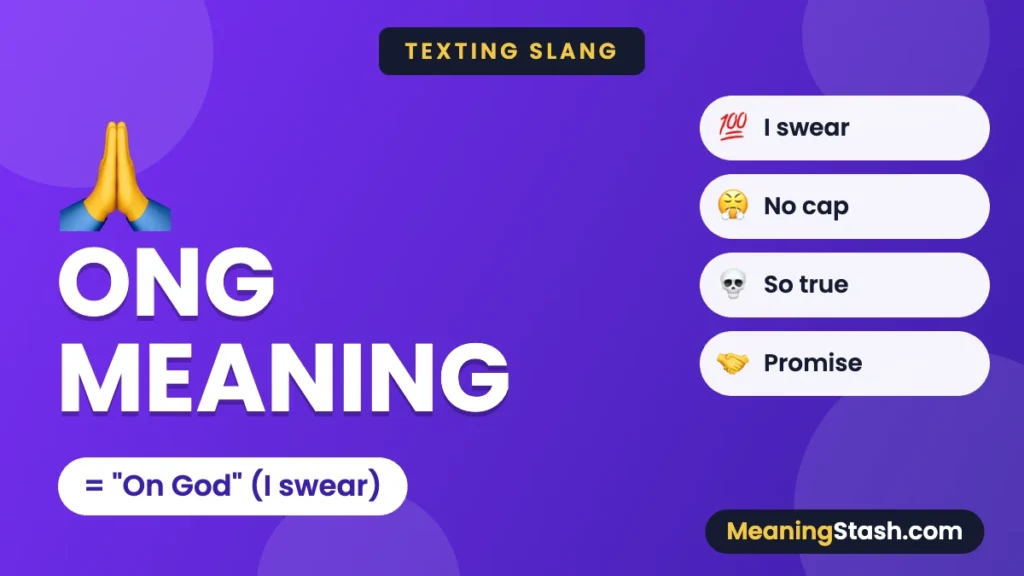
ONG usually means “on God” in a casual text or social-media comment. It emphasizes that the sender is serious, telling the truth or strongly agreeing. It is similar to “I swear” or “I really mean it.”
It does not prove that a claim is true. It tells you how strongly the person wants the statement to sound. The words around the abbreviation still matter.
ONG meaning in text at a glance
| Message | Likely meaning |
|---|---|
| “ONG, I didn’t take your charger.” | I swear I am telling the truth. |
| “I’ll send it tonight, ong.” | I really intend to keep the promise. |
| “That journey took forever.” “ONG.” | I strongly agree. |
| “Ong?” | Are you really serious? Read the conversation for confirmation. |
Three ways people use ONG
To emphasize a claim
“That was the best sandwich I’ve had, ong.” The abbreviation adds emphasis. The sender is not usually making a carefully measured comparison of every sandwich they have eaten.
To strengthen a promise
“I’ll return your book tomorrow, ONG.” Here it functions like an informal oath. You can acknowledge the promise without repeating the expression.
To agree with a reaction
“The last question was difficult.” “Ong.” A one-word reply can mean “Exactly” or “That is so true.” This use is especially easy to understand when you can see the message being answered.
ONG vs OMG and FR
| Abbreviation | Full form | Main job |
|---|---|---|
| ONG | On God | Emphasizes truth, seriousness or agreement |
| OMG | Oh my God | Usually expresses surprise or a strong reaction |
| FR | For real | Shows sincerity, agreement or a question about truth |
FR meaning in text overlaps with ONG, but it does not use the same religious wording. In a rushed message, ONG could also be a typo for OMG; do not ignore a sentence that clearly expresses surprise.
How to reply naturally
- A claim: “Really? What happened?”
- A promise: “Thanks. Tomorrow works for me.”
- Agreement: “Exactly” or a response that continues the discussion.
- Uncertainty: “Do you mean you’re serious?”
You do not have to copy the sender’s slang. A plain reply is often clearer, especially if you are unfamiliar with their usual texting style.
Tone, religion and context
The phrase refers to God, even when a sender uses it casually rather than as a statement of faith. Some readers are uncomfortable with casual religious oaths. Avoid treating that reaction as a misunderstanding; choose “honestly,” “seriously” or “I promise” when those fit better.
ONG is informal. In client emails, applications and school assignments, write the meaning directly. The alternatives to seriously can help you choose wording that suits the situation.
Emojis can change the tone further. “ONG 💀 Skull” after a joke may combine agreement with the 💀 skull emoji meaning of exaggerated laughter. It is different from using a 💀 skull in a real warning.
Other contexts can use the same letters
Capital letters are not a guarantee of a slang meaning. An organization, product or specialist discussion can use ONG differently. In a conversation about a named service or technical term, check that context rather than automatically expanding it to “on God.”
For everyday chat, ONG belongs among texting abbreviations whose meaning comes from the surrounding exchange.
Frequently asked questions
What does ONG stand for?
In casual texting it usually stands for “on God,” an expression of seriousness, honesty or strong agreement.
Does ONG mean the same as OMG?
No. ONG emphasizes seriousness or agreement; OMG usually expresses surprise. A typo is possible, so read the sentence.
What does ONG FR mean?
It combines “on God” and “for real” for extra emphasis. It still does not establish that a claim is factually true.
Is ONG always religious?
Not in the sender’s intent, but its wording refers to God. Some audiences may find casual use inappropriate.