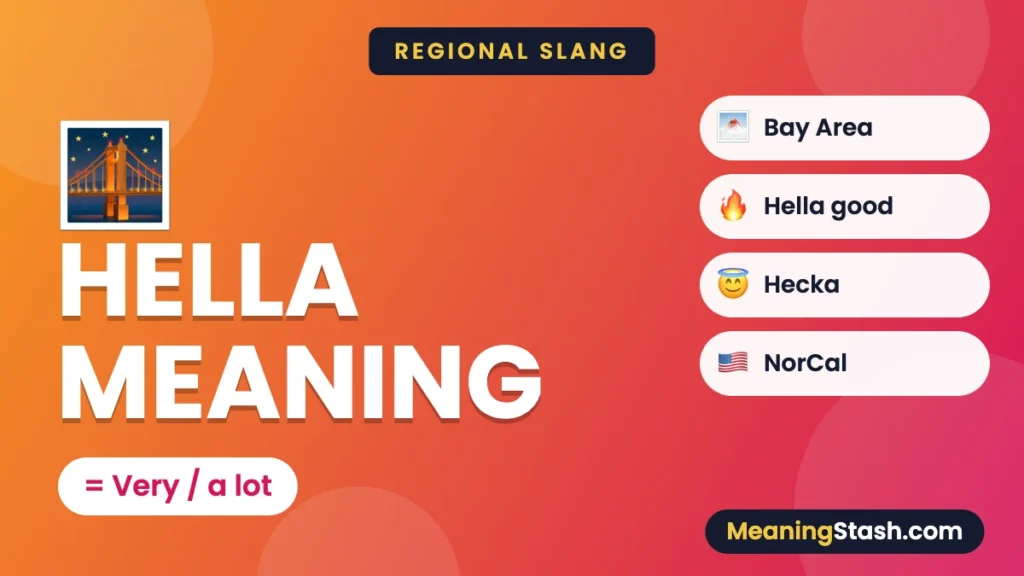
Hella means “very,” “extremely” or “a lot of” in informal speech. “Hella cold” means very cold. “Hella people” means a lot of people. The word adds intensity rather than naming a separate object or feeling.
It is strongly associated with Northern California, especially the Bay Area, but people outside that region may use or recognize it too. A person’s use of the word does not establish where they live.
Hella meaning in different sentence patterns
| Pattern | Example | Plain-English version |
|---|---|---|
| Before an adjective | “That hill is hella steep.” | That hill is very steep. |
| Before an adverb | “They finished hella quickly.” | They finished extremely quickly. |
| Before a noun | “There’s hella traffic today.” | There is a lot of traffic today. |
| Before a plural noun | “We took hella photos.” | We took many photos. |
What kind of word is hella?
In a phrase such as “hella good,” it acts as an intensifier: a word that strengthens the description. Before a noun, it expresses quantity. You can usually understand the sentence by replacing it with very, much or many, depending on the grammar.
The same substitute will not fit every pattern. “Very photos” is not natural English, so “hella photos” needs “many photos” or “a lot of photos,” not a word-for-word replacement.
Regional background without a fixed stereotype
Hella is well known as a Northern California expression and is associated with a shortened form of phrases built around hell of. Language spreads through friendships, music, travel and online conversation, so its use is not confined to one place.
A different regional expression can do a completely different job. Mandem refers to a group of friends in British slang; it is not another way to intensify “good.” Understanding a word’s function is more useful than treating all slang as interchangeable.
Is hella rude, and what is hecka?
Hella is casual and contains the sound of hell. Some people consider it mild swearing or dislike it in certain settings. Others use it as an ordinary part of their informal speech. Audience and house rules matter.
Hecka is a softened alternative some speakers use. It is still informal; replacing hella with hecka does not automatically make a sentence suitable for a job application.
Natural examples and formal alternatives
- “The café was hella busy.” → “The café was very busy.”
- “That took hella effort.” → “That took a great deal of effort.”
- “We walked hella far.” → “We walked a long way.”
- “The ending was hella funny.” → “The ending was extremely funny.”
If a formal sentence sounds padded with very or extremely, use a precise adjective instead. The alternatives to busy might include a more exact word for a crowded café or a demanding schedule, but the right choice depends on the meaning.
Adding FR, meaning for real, supplies another layer of emphasis: “That was hella funny fr.” You do not need both expressions to make a clear point.
Common misunderstandings
Hella does not always praise something. “Hella expensive” can be a complaint, while “hella impressive” is praise. The adjective or noun carries much of the message; hella makes it stronger.
Use it where it fits your normal voice and audience. In the regional slang cluster, the useful question is how an expression works, not whether every person from a region says it.
Frequently asked questions
Does hella mean hello?
No. In these slang uses it means very, extremely or a lot of.
Can hella mean many?
Yes. Before a plural noun, as in hella people, it can mean many or a lot of.
Is hecka formal English?
No. It is a softened informal alternative, not a formal substitute for every context.
Can people outside California use hella?
Yes. It is associated with Northern California, but slang can spread and be used elsewhere.