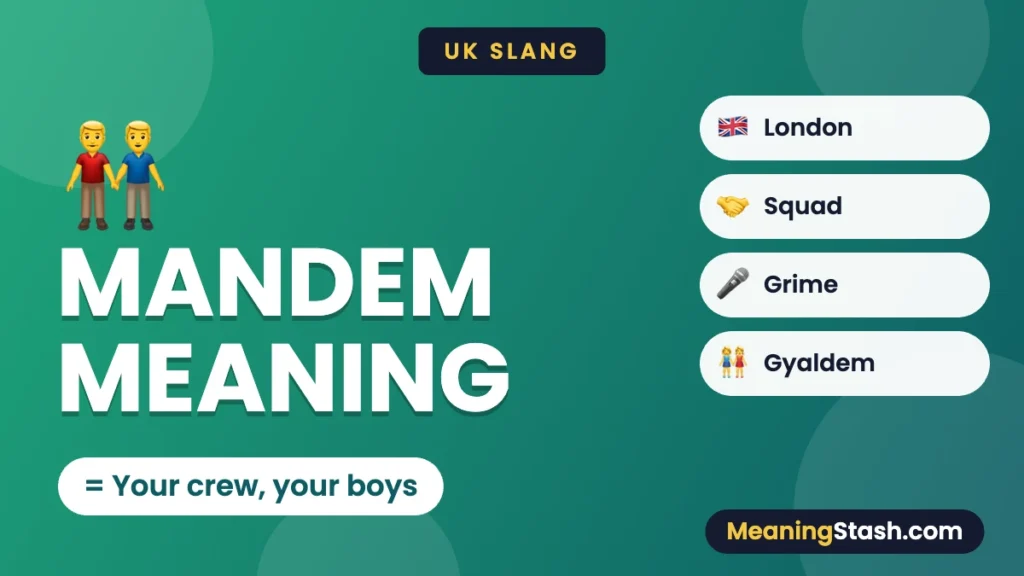
Mandem usually means a group of close male friends in British slang. In “I’m meeting the mandem,” it refers to the speaker’s friends or crew. It is a collective expression, not normally a label for one individual.
The word is associated with Black British and London speech and has Caribbean linguistic roots. You may encounter it in conversation, music and online posts, but context is more reliable than assumptions about who “should” use a word.
Mandem meaning with everyday examples
| Example | Plain-English meaning |
|---|---|
| “The mandem are coming over.” | The group of friends is coming over. |
| “I watched the match with the mandem.” | I watched it with my male friends. |
| “A photo with the mandem.” | A photo with the crew or friends. |
“The mandem” often refers to a known group. It does not automatically mean a gang, a criminal group or every man in a place. Those associations should not be inferred from the word alone.
Where mandem comes from
The word combines man with a Caribbean form related to them. In Jamaican-influenced speech, dem can help mark a group or plurality. The expression became associated with British urban speech through the interaction of communities and language varieties.
It is more accurate to describe these roots than to invent one person, song or social-media app that supposedly created the word. A dictionary’s first recorded example is also not necessarily its first use in speech.
How the word behaves in a sentence
Because mandem normally refers to people as a group, sentences such as “The mandem are here” are easy to understand. You will also encounter variation in informal speech. Slang does not always follow the conventions expected in a formal report.
For formal writing, use friends, colleagues, members of the group or another term that accurately identifies the people. The words related to friends offer options, but colleagues and friends do not mean exactly the same thing.
Related slang without assuming identical meanings
| Expression | Broad use |
|---|---|
| Mandem | A group of close male friends |
| Gyaldem / galdem | A related expression for a group of girls or women |
| Fam | An affectionate address for someone treated as close |
| Bruv | A casual address related to brother |
| Crew | A group, which need not be male or close friends in every use |
Do not assume that a word can be substituted into every sentence simply because it appears in a slang list. Hella concerns intensity, while FR concerns sincerity or agreement. Neither names a friend group.
Is mandem offensive?
It is not inherently a slur. However, tone, context and imitation matter. Exaggerating a community’s accent or using the expression as a stereotype can be disrespectful even when the word itself is not an insult.
When quoting a message, keep the context. When writing in your own voice, choose words you understand and that suit your relationship with the people involved.
How to interpret it in a message
If someone says “Out with the mandem,” a straightforward reading is that they are spending time with friends. You do not need to infer romantic intentions, employment status or criminal activity. Ask if the reference to a specific group matters.
These context checks are useful across regional and cultural slang, especially when an expression reaches a new audience through entertainment.
Frequently asked questions
Does mandem mean one man?
Its usual meaning is a group of close male friends. Informal local uses can vary, so read the whole sentence.
Does mandem automatically mean gang?
No. The word alone does not establish a criminal connection. It commonly refers to friends or a crew.
Can mandem refer to a mixed group?
Its standard slang sense centers on male friends. Speakers may broaden it locally; friends or crew is clearer when you want a gender-neutral description.
Is mandem suitable for a formal email?
Usually not. Use a precise term such as friends, colleagues or group members, depending on who you mean.