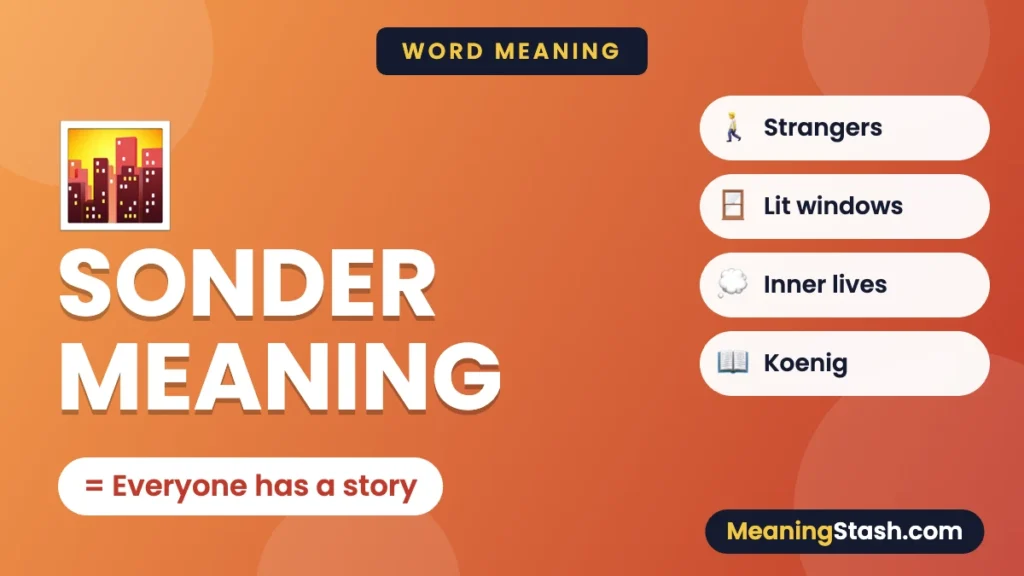
Sonder describes a moment of realizing that strangers have their own full inner lives. The person beside you on a train has memories, responsibilities, relationships and worries that you may never know about.
Writer John Koenig coined the word for The Dictionary of Obscure Sorrows, a project that creates names for experiences that can be hard to express. It is a modern coinage, not an ancient diagnosis or a scientific measurement.
Sonder meaning in simple words
Imagine looking at the windows of an apartment building at night. You can see a few lights, but behind each one someone is living a story that does not revolve around you. Becoming aware of those many separate perspectives is the idea the word captures.
You do not have to feel sad for the idea to apply. A person may describe the moment as humbling, comforting, moving, curious or bittersweet.
Where the word comes from
Koenig introduced sonder as part of his creative vocabulary project. It later circulated through writing and online conversation. The important attribution is to the creator, rather than an unsupported claim that an old language already had exactly the same term and definition.
A coined word can become useful through use. That does not mean everyone knows it or that every dictionary includes it. For an unfamiliar audience, give a short explanation instead of assuming the word will be recognized.
Sonder vs empathy, nostalgia and loneliness
| Word | Core idea | How it differs |
|---|---|---|
| Sonder | Awareness of strangers’ independent inner lives | Centers on perspective |
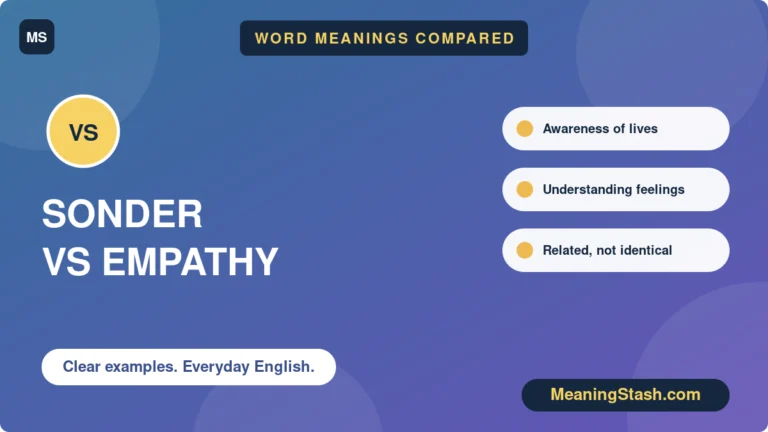
| Empathy | Understanding or sharing another person’s feelings | Can follow that awareness but is not the same experience |
| Nostalgia | Longing or affection connected with the past | Centers on memory |
| Loneliness | A feeling of unwanted isolation | Is not required for sonder |
The meaning of empathy can help distinguish recognizing another life from understanding a particular feeling in it.
Examples of sonder in a sentence
- “Watching the commuters leave the station gave me a moment of sonder.”
- “The novel creates sonder by showing the private worries of its minor characters.”
- “I felt sonder when I noticed how many different lives passed through the café.”
These are illustrative examples, not quotations from a study or a report. Use the noun when it adds a useful idea; plain wording such as “I remembered that everyone has their own concerns” can be clearer in a work message.
What the idea does not tell you
Recognizing that another person has a complex life does not tell you the details of it. Do not infer their history, motives or feelings from a brief glimpse. Curiosity can encourage a more patient response, but it should not turn into a confident story about a stranger.
The word is also not a diagnosis, a personality type or proof of a spiritual connection. It names a perspective that people can describe in different ways.
Related feelings and settings
Liminal space centers on an in-between place or stage. A railway station can prompt both ideas: it is a transitional setting, and it contains many people with separate destinations. The place and the awareness are still different concepts.
A moving realization may be expressed with words or a 🥹 face holding back tears emoji, but no emoji confirms that someone is experiencing sonder specifically.
For another hard-to-name idea, a search for a feeling’s meaning can suggest possible words. Check each suggestion’s definition; a reverse dictionary ranks related ideas rather than identifying your exact experience.
Frequently asked questions
Who coined sonder?
John Koenig coined it for The Dictionary of Obscure Sorrows.
Is sonder always a sad feeling?
No. People can find the perspective moving, comforting, humbling or bittersweet.
Is sonder the same as empathy?
No. Sonder concerns awareness of other people’s independent lives. Empathy concerns understanding or sharing another person’s feelings.
Can I use sonder in formal writing?
You can, if it suits the purpose and you explain it for readers who may not know the coined term.