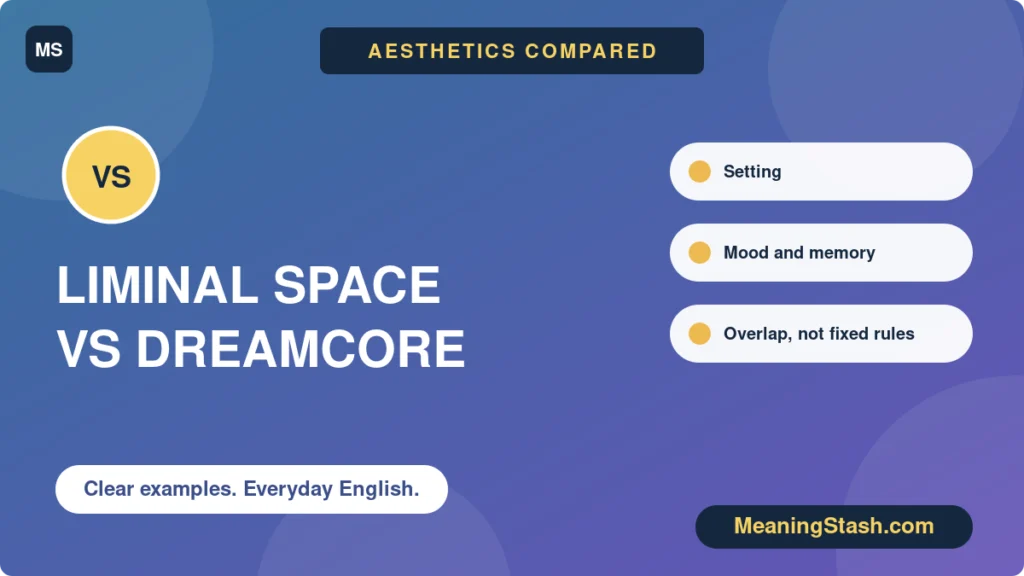
Liminal space vs dreamcore compares a transitional-place concept with a broader dreamlike aesthetic. A liminal space can be a hallway, station or waiting area between destinations. Dreamcore uses dreamlike combinations, memory and unreality, which may include liminal-looking places but is not limited to them.
Online labels overlap, and communities use them differently. Treat this comparison as a way to describe images more precisely, not a test with one official answer for every picture.
Liminal space vs dreamcore at a glance
| Question | Liminal space | Dreamcore |
|---|---|---|
| What is emphasized? | A threshold, transition or in-between setting. | A dreamlike atmosphere or experience. |
| Must it be an ordinary place? | Many examples are recognizable physical spaces. | It may be ordinary, altered or impossible. |
| Must it be frightening? | No. | No. |
| Can one image fit both? | Yes. An empty corridor edited into a dreamlike scene may invite both labels. | |
What makes a space liminal?
The broader liminal space meaning concerns being between states, places or stages. In physical examples, a corridor connects rooms and a departure lounge sits between arriving at an airport and boarding a plane.
Online images often emphasize emptiness, unfamiliar timing or a familiar place without its usual activity. Emptiness is a common aesthetic choice, not a requirement for every meaning of liminal.
What makes an image dreamcore?
Dreamcore is commonly used for dreamlike visual work: an ordinary room opening into the sky, a playground placed in an impossible landscape or familiar objects arranged with dream logic. Nostalgia, softness or unease can all appear.
These are illustrative motifs, not a checklist every creator must follow. Adding one cloud or a childhood object does not automatically determine the image’s genre.
Three examples to compare
An empty hotel corridor: its transitional function supports a liminal-space reading. It may feel eerie, peaceful or simply quiet. No surreal editing is necessary.
A bedroom floating above a sea of clouds: the impossible setting supports a dreamcore description. It need not be a transitional space.
A school hallway ending in an endless sky: the hallway supplies an in-between setting while the impossible ending creates dreamlike unreality. Both labels may be useful.
Dreamcore, weirdcore and the Backrooms
Weirdcore is another flexible internet label often associated with strange, disorienting or deliberately uncanny imagery. Dreamcore and weirdcore can overlap without having identical moods.
The Backrooms refers to a fictional setting and related creative lore. A real empty office corridor can remind viewers of it, but that does not make the place a literal entrance to a fictional world.
How to describe an image without overlabeling it
Name what is actually visible before interpreting the mood: “An empty tiled corridor with fluorescent lighting” is observable. “A corridor that feels nostalgic and dreamlike” adds a subjective response.
The synonyms for uncanny can help distinguish eerie, strange and unfamiliar, but those words do not all mean the same thing. If you remember a feeling but not the word, describe it in the Reverse Dictionary and check the suggested definitions.
Another feeling sometimes discussed alongside reflective imagery is sonder, the awareness of other people’s complex lives. It describes an experience of perspective, not a visual aesthetic.
Frequently asked questions
Is every empty room a liminal space?
No. Emptiness alone does not establish a transitional function, though online aesthetic labels are sometimes used more loosely.
Does dreamcore have to be scary?
No. It can feel comforting, nostalgic, strange or unsettling.
Can an image be both dreamcore and liminal?
Yes. A transitional setting can also have a dreamlike treatment.
Are these scientific classifications?
No. Internet aesthetic labels are flexible cultural descriptions, not diagnostic or universally standardized categories.