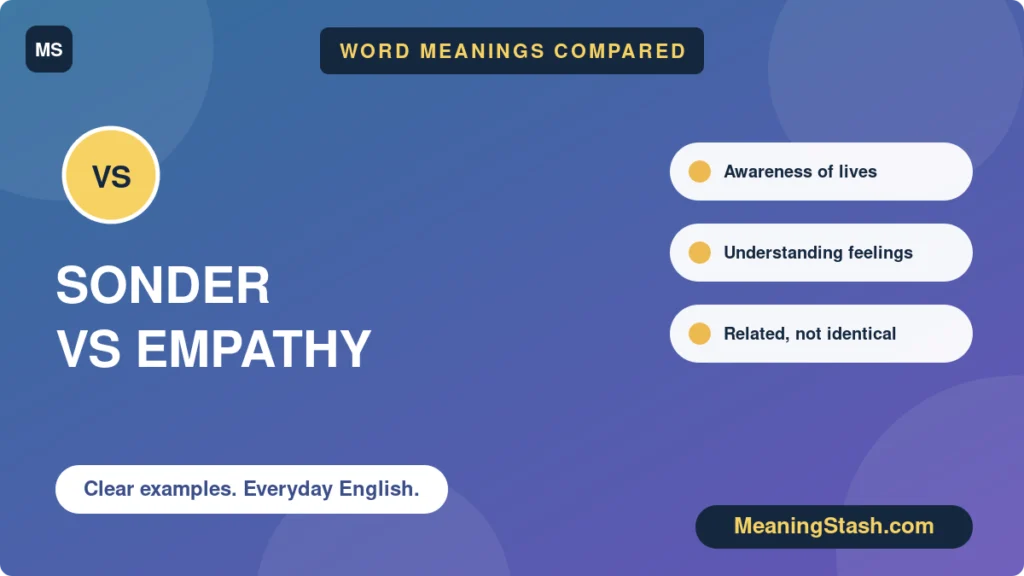
Sonder vs empathy is a distinction between noticing the complexity of other people’s lives and understanding or sharing another person’s feelings. Sonder names a realization about people beyond yourself. Empathy concerns how you relate to a person’s experience or emotional perspective.
The experiences can support each other, but they are not identical. You can recognize that a stranger has a full life without knowing what that stranger feels.
Sonder vs empathy at a glance
| Idea | Central focus | Example |
|---|---|---|
| Sonder | Other people have complex lives beyond what you see. | You notice commuters and consider that each has relationships, plans and concerns. |
| Empathy | Understanding or sharing someone’s perspective or feelings. | You listen to a friend’s disappointment and try to understand it from their position. |
| Sympathy | Concern or compassion for another person. | You express sorrow that a colleague is having a difficult time. |
What sonder adds to the comparison
Sonder is a modern coined word associated with John Koenig’s creative project, The Dictionary of Obscure Sorrows. The sonder meaning and origin explain that background. It is not an ancient clinical term or a diagnosis.
The realization can arise in a crowd, a quiet street or an everyday interaction. It does not tell you the actual contents of another person’s life. Imagining a stranger’s story is different from knowing it.
What empathy adds
Empathy involves an attempt to understand another person’s experience, and in some uses to share their emotional response. It may draw on what they tell you, what you observe and your own experience, but those clues can be incomplete.
For example, a friend says they are disappointed about a canceled visit. Listening and recognizing why it mattered can be empathetic. Assuming they must feel exactly as you would may lead to a mistaken response.
The definition of empathy gives the established word’s range. It should not be reduced to mind-reading or automatically agreeing with every opinion.
Can you feel sonder without empathy?
Yes. You might recognize the complexity of a stranger’s life while having little information about their emotions. That is awareness without a specific emotional understanding.
The reverse can also happen: you can respond empathetically to a close friend without having a dramatic realization about humanity. The two labels describe different aspects of an experience rather than stages everyone must pass through.
Everyday situations that show the difference
- On a train: noticing that every passenger has commitments beyond this journey fits sonder.
- During a conversation: hearing why a friend is anxious and reflecting that understanding fits empathy.
- After a mistake: considering another person’s circumstances may encourage patience, but you still need facts before deciding what happened.
Reflective settings are sometimes called liminal spaces. A transitional setting might prompt thought, but the setting, sonder and empathy are three different concepts.
Use the words precisely
Write “I had a moment of sonder watching the crowd” if you mean the realization. Write “She responded with empathy” if you mean understanding someone’s experience. If the word feels uncertain, describe the event in ordinary language first.
The Reverse Dictionary for feelings and ideas can suggest related words. Check definitions before choosing; compassion, sympathy and empathy are related without being exact replacements.
Frequently asked questions
Is sonder a type of empathy?
It can encourage perspective-taking, but it names a different realization and is not generally a formal clinical subtype of empathy.
Does empathy mean agreeing with someone?
No. You can try to understand a person’s perspective while disagreeing with a conclusion or action.
Does sonder mean loneliness?
Not necessarily. It may feel moving, connecting, unsettling or neutral depending on the person and situation.
Can either word tell me what a stranger is thinking?
No. Recognizing complexity and trying to understand someone are not access to their private thoughts.