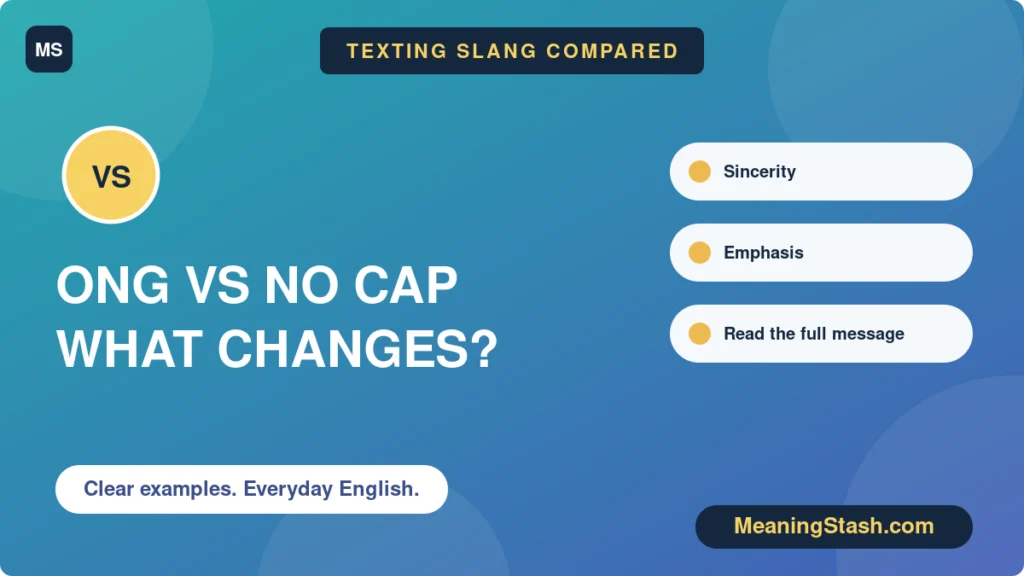
ONG vs no cap meaning comes down to two informal ways of emphasizing sincerity. ONG commonly stands for “on God,” used like an emphatic promise or agreement. “No cap” means “no lie” or “I’m being honest.” They can overlap, but their wording and tone are different.
Neither expression proves a statement is true. Someone can use sincere-sounding language while joking, exaggerating or being mistaken.
ONG vs no cap meaning at a glance
| Expression | Common function | Example |
|---|---|---|
| ONG | Strong assurance or agreement. | “ONG, that was the hardest level.” |
| No cap | Insistence that a statement is honest. | “That was the hardest level, no cap.” |
| FR | “For real”: agreement, emphasis or a question. | “That was difficult, FR.” |
These are common conversational readings, not fixed intensity levels. The speaker, relationship and sentence all affect the tone.
How ONG works in a conversation
In “ONG, I sent the file,” the speaker emphasizes the claim. As a short reply to “That match was incredible,” ONG can strongly agree. The ONG meaning in text explains the abbreviation and how it differs from a typo for OMG.
Because the expanded wording invokes God, some people avoid it for religious, cultural or personal reasons. Use an alternative that suits the people you are speaking with; do not pressure someone to copy your slang.
How no cap changes the sentence
“Your presentation was excellent, no cap” presents the compliment as genuine rather than flattery. “I waited an hour, no cap” insists that the duration is not an exaggeration. Whether either claim is accurate must be judged separately.
“Cap” can be used to accuse a statement of being false, so “That’s cap” may sound confrontational. “No cap” is not automatically confrontational; it can be enthusiastic, playful or defensive.
Can you replace one with the other?
Sometimes: “ONG, this is my favorite song” and “This is my favorite song, no cap” both emphasize sincerity. They are not interchangeable in every position, and the religious wording of ONG adds a distinction that “no cap” does not share.
As a question, FR meaning “for real?” may be clearer than a bare ONG or “no cap?” when you simply want confirmation. You can also ask “Seriously?” or “Do you mean that?”
How to reply naturally
- Agreement: “Exactly—that’s how I felt too.”
- A compliment: “Thank you. I appreciate that.”
- A claim you need to confirm: “Can you send me the confirmation?”
- A joke: Respond to the joke if the tone is clear.
Do not treat slang as evidence when a fact matters. If a friend says a train is canceled, check the actual travel information rather than relying on how strongly they phrase it.
Clear alternatives for different settings
“Honestly,” “seriously,” “I mean it” and “I’m not exaggerating” may fit casual writing. The synonyms for honestly offer alternatives, but check the specific sense before replacing a word.
For work or study, state the observation directly: “I submitted the report at 2:15 p.m.” is more useful than adding repeated assurances.
Frequently asked questions
Do ONG and no cap mean exactly the same thing?
Their sincerity uses overlap, but ONG expands to on God, while no cap means no lie. Context and personal preferences matter.
Is ONG stronger than no cap?
There is no universal scale. A speaker’s delivery and situation determine the emphasis.
Does no cap make a statement reliable?
No. It is an expression of claimed honesty, not independent evidence.
Should I use both in one message?
You can encounter that combination, but stacking slang may sound exaggerated. Use wording that feels natural to you.