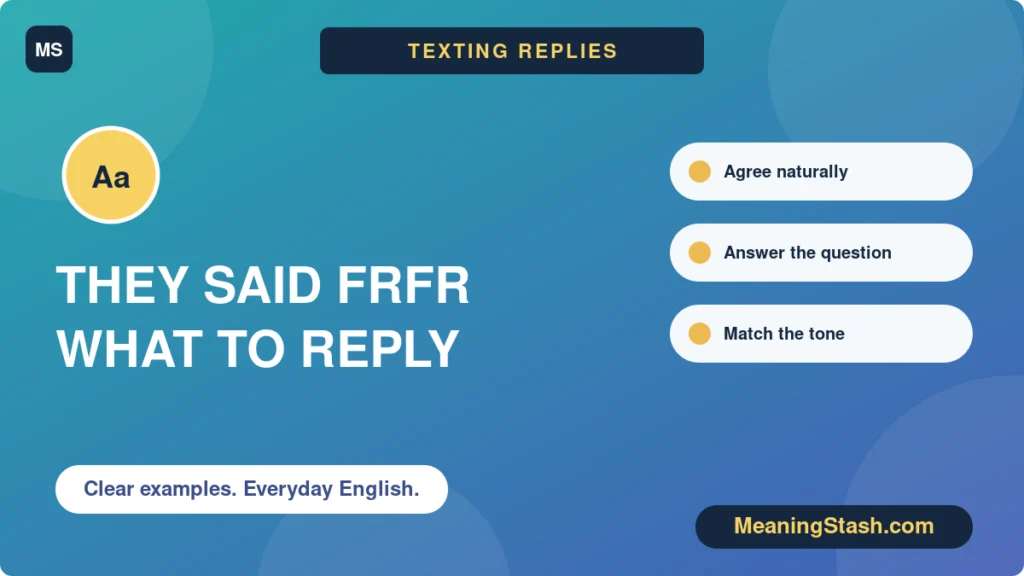
How to reply to FRFR depends on whether it expresses agreement, asks for confirmation or adds emphasis. “Exactly” can answer agreement. “Yes, seriously” can confirm a surprising statement. After a compliment, “Thank you—I appreciate that” is usually enough.
FRFR commonly means “for real, for real.” You do not need to repeat the abbreviation or learn a special reply code to keep the conversation natural.
How to reply to FRFR in different situations
| Their message | What it may be doing | Your reply |
|---|---|---|
| “We need a break, FRFR.” | Emphasizing agreement or tiredness. | “Definitely. Let’s stop for lunch.” |
| “You got the job? FRFR?” | Asking for confirmation. | “Yes! They called this morning.” |
| “That design looks great, FRFR.” | Giving an emphatic compliment. | “Thank you. I worked hard on it.” |
| “I’m upset about it, FRFR.” | Asking to be taken seriously. | “I hear you. Do you want to talk?” |
First, decide whether it is a question
“FRFR?” after unexpected news often means “Are you serious?” Answer that directly. “Yes, I mean it,” “Yes, it’s confirmed,” or “No, I was joking” resolves the question without adding confusion.
Without a question mark, FRFR may simply strengthen the statement. Punctuation is a clue, not a guarantee; some people omit it in casual messages. The broader FR and FRFR meanings explain how the abbreviation can function in several positions.
Replies when someone agrees with you
“Exactly,” “That’s what I thought,” “Same here,” and “I know what you mean” can all work. Choose one that actually matches your opinion. Agreement does not require you to copy every word the sender uses.
To continue, add a relevant detail: “Exactly. The second half was much better.” To close naturally, a brief acknowledgment may be enough. You do not need to create a new topic after every short reaction.
Replies to a compliment
Accept the compliment clearly: “Thank you—that’s kind,” or “I’m glad you liked it.” If you return a compliment, make it genuine rather than automatic.
FRFR can emphasize sincerity without implying romance. Read the actual compliment and relationship before deciding that it is flirting. A classmate praising your notes may simply appreciate the help.
When the message is serious
Respond to the problem rather than the slang. “That sounds frustrating. What happened?” can fit a difficult experience. If someone requests practical help, answer what you can realistically do.
“I’ll handle everything” may create an expectation you cannot meet. A specific offer such as “I can help with the first paragraph this evening” is easier to understand.
When you do not agree
You can disagree respectfully: “I see why you think that, but my experience was different.” The alternatives to seriously can help express tone, but plain sentences usually work better than replacing one piece of slang with several others.
If FRFR appears alongside ONG in a message, the sender may be emphasizing the same point repeatedly. Repetition does not require a more dramatic reply or prove that the claim is accurate.
Frequently asked questions
Can I reply FR back?
Yes, if you are genuinely agreeing and it suits your style. A normal sentence is equally acceptable.
Is FRFR rude?
Not inherently. Tone depends on what is being said and the relationship between the speakers.
Does FRFR from a crush mean flirting?
The abbreviation alone does not establish romantic interest. Read the invitation or compliment itself.
Should I use FRFR in a formal email?
A direct phrase such as “I agree” or a clear factual statement is usually better in formal communication.