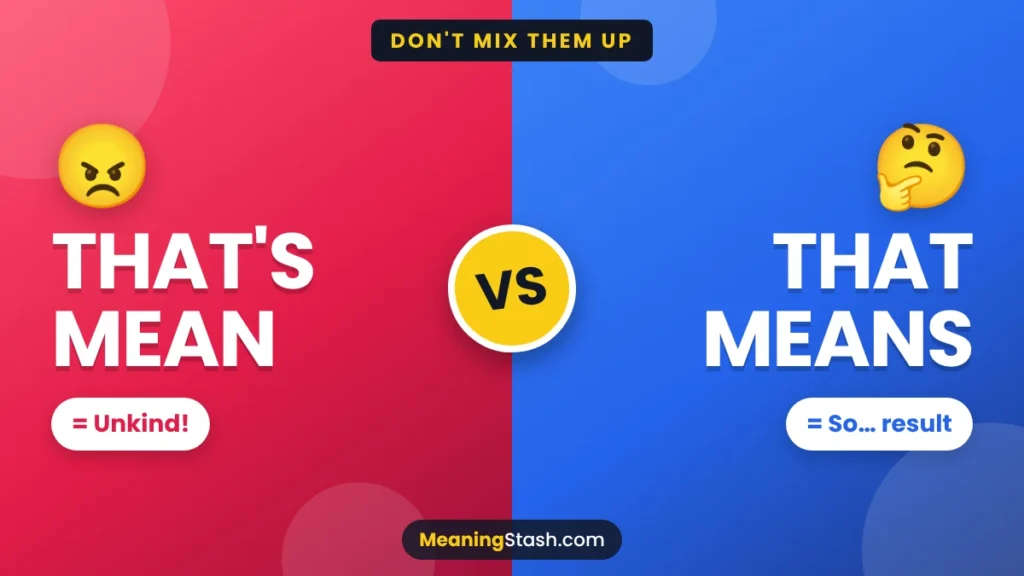
“That’s mean” means “that is unkind.” “That means” explains what something signifies or what follows from it. The apostrophe and the final s show different grammar, not two spellings of the same phrase.
Compare “You hid my invitation? That’s mean” with “The event is cancelled. That means we can stay home.” The first judges an action. The second explains a consequence.
That’s mean vs that means: the quick difference
| Phrase | Grammar | Use |
|---|---|---|
| That’s mean | That is + the adjective mean | Describes something as unkind |
| That means | That + the verb means | Explains a meaning, implication or result |
| That’s what it means | That is what + subject and verb | Another grammatical sentence with a different structure |
When to use “that’s mean”
Here, that’s is a contraction of that is. The word mean is an adjective describing an action or comment as unkind.
- “Laughing at her mistake? That’s mean.”
- “That’s a mean thing to say about someone.”
- “You saved the best biscuit for yourself? That’s mean!”
The last example could be playful between friends. Tone, punctuation and the relationship determine whether the speaker is genuinely hurt or teasing. The phrase does not always mean that the whole person is cruel.
If you need a more precise description, words related to unkind include alternatives with different levels of strength. Thoughtless, rude and cruel are not automatically interchangeable.
When to use “that means”
Here, means is a verb. It can introduce a definition, consequence or interpretation.
- “EOD stands for end of day. That means the deadline is linked to the end of a day.”
- “The bus leaves in ten minutes. That means we should go now.”
- “You remembered my birthday. That means a lot to me.”
The third sentence expresses emotional importance. Although it concerns feelings, it still needs means. A useful rule must follow the grammar, not simply divide all sentences into “emotional” and “logical.”
For a real work deadline, the EOD cutoff also depends on the date, time and time zone agreed by the team.
Two quick tests
Expand that’s to that is
“That is mean” makes sense when you are describing unkind behavior. “That is means we are late” does not. The second sentence needs “That means we are late.”
Check the past tense
“That’s mean” becomes “That was mean.” “That means” becomes “That meant.” In the first phrase, is changes. In the second, the verb mean changes.
Questions and common mistakes
Use “Does that mean…?” rather than “Does that means…?” The helper does takes the third-person marking, so the main verb stays mean.
Similarly, write “What does that mean?” and “I know what that means.” The first is a question with does; the second is a statement without it.
The dictionary meanings of mean show why one word can work as an adjective or a verb. This is different from gray vs grey, where two spellings usually share the same meaning.
Short practice: choose the right phrase
- “You deliberately left her out. ______.”
- “The tickets sold out. ______ we need another plan.”
- “You helped me move. ______ a lot.”
Answers: 1. That’s mean. 2. That means. 3. That means. In the third example, means a lot describes importance; it does not judge someone as unkind.
Frequently asked questions
Is that’s mean grammatically correct?
Yes, when it means “that is unkind.” It cannot normally replace “that means” before a consequence.
Why does that means have an s?
That is a singular third-person subject, so the present-tense verb is means.
Can I write thats without an apostrophe?
In standard edited English, use that’s for the contraction of that is. The verb phrase that means has no apostrophe.
Is that means always followed by that?
No. “That means we are late” and “That means that we are late” are both possible.