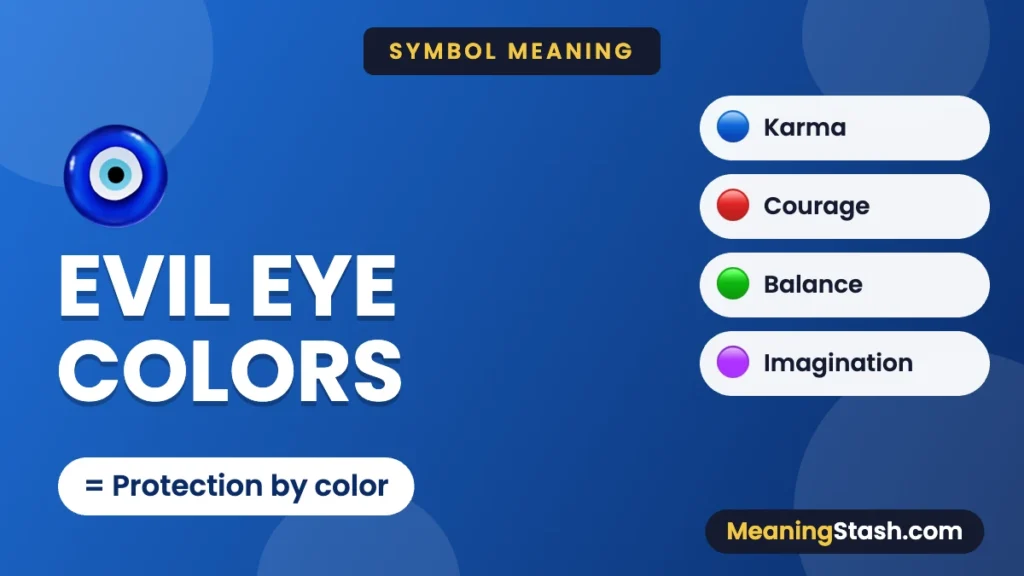
Evil eye color meanings are symbolic associations, not a universal code. Blue is widely associated with eye-shaped protective charms, while modern jewelry charts may connect red with courage, green with growth and white with peace. The details vary by community, maker and seller.
The phrase evil eye can refer to a belief about harmful envy or a look thought to bring misfortune. An eye-shaped amulet is a symbol used in traditions that respond to that belief. Describing the tradition does not establish that an object or color can prevent harm.
Evil eye color meanings: a cautious comparison
| Color | Commonly presented association | How to read it |
|---|---|---|
| Dark blue | Protection, calm or watchfulness | A familiar color for eye-shaped charms |
| Light blue | Peace or clarity | A symbolic interpretation, not an effect |
| Red | Courage or energy | Often a modern intention or gift theme |
| Pink | Affection or friendship | Meanings depend on the maker and wearer |
| Green | Growth or balance | Not a guarantee of success or money |
| Purple | Imagination or reflection | Not a standard shared by every tradition |
| White | Peace or a fresh start | Also an aesthetic choice |
| Black | Strength or a bold style | Does not establish stronger protection |
This table summarizes familiar ways the colors are described. It should not be treated as a religious rulebook, a historical chart applying everywhere, or evidence that a charm changes health, luck or other outcomes.
The belief and the object are different
People sometimes say “I’m wearing an evil eye” when they mean the eye-shaped charm, rather than the harmful look itself. In Turkish contexts, nazar boncuğu refers to a familiar type of eye bead. Related beliefs and objects appear in more than one culture, with different names and practices.
Do not assume that every eye-shaped symbol has the same origin. For example, an ancient Egyptian eye amulet and a modern blue glass eye bead should not automatically be described as one identical object or tradition.
Why different color charts disagree
Some charts describe local traditions; others describe a designer’s intentions or modern color symbolism. A seller can attach a special meaning to a collection without establishing a universal historical definition.
If you are discussing a particular object, the maker’s description, the wearer’s explanation and its cultural setting are more informative than a general internet chart.
Choosing a color as a symbol
A person may choose a charm because it connects with their family, a belief, a gift or an outfit. If you are giving one, ask what the symbol means to the recipient rather than assuming that the color will communicate a fixed message.
Heart emoji color meanings also depend on context, but those texting conventions should not be used as proof of an amulet’s traditional meaning. A 🤍 white heart emoji and a white charm can share an aesthetic without sharing one official definition.
What if the charm breaks?
Some people interpret a broken charm as having served a symbolic purpose. Others see it simply as damaged jewelry. A break does not demonstrate that negative energy was absorbed or that a future event has been predicted.
Likewise, a recommendation about the “correct” wrist can belong to a particular belief or personal practice. It is not a universally established requirement.
Repeated numbers and other symbolic systems
111 angel number meaning belongs to a different set of modern spiritual interpretations. Comparing symbolic systems can be interesting, but one does not verify the claims of another.
Our symbolic meanings articles distinguish what people believe or express from what can be established as a factual effect.
Frequently asked questions
Which evil eye color is the most powerful?
There is no objective evidence that one color provides stronger protection. Blue is a familiar traditional choice, while other colors can carry personal or modern symbolic meanings.
Does green guarantee wealth or success?
No. Growth or success can be symbolic associations, not a guarantee of a financial or life outcome.
Do all cultures use the same color meanings?
No. Traditions, products and personal interpretations differ. Avoid treating one chart as universal.
Does a broken charm prove it protected me?
No. That is an interpretation in some belief systems, not something the break itself can establish.