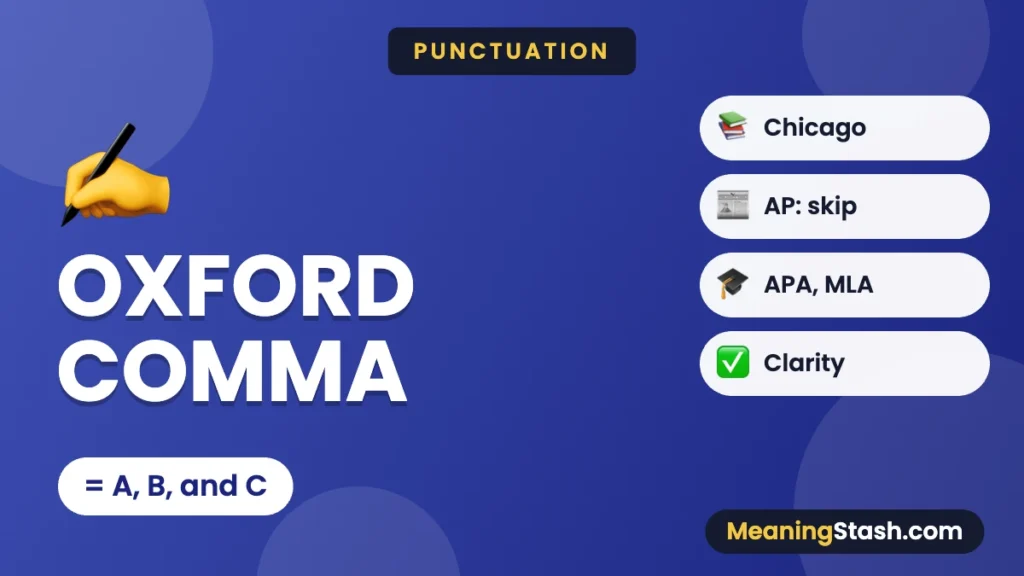
The Oxford comma is the comma before the final “and” or “or” in a list of three or more items. In “pens, folders, and paper,” it is the comma after folders. It is also called the serial comma.
Whether you routinely use it depends on your style guide. The main goal is a list that readers can understand without guessing which words belong together.
Oxford comma rules at a glance
| Situation | Example | What to notice |
|---|---|---|
| Three separate items | Tea, coffee, and juice | The final comma is the Oxford comma. |
| A style that omits it | Tea, coffee and juice | This can also be correct under the chosen style. |
| Only two items | Tea and coffee | A routine serial comma is unnecessary. |
| Items already containing commas | Bath, England; Cork, Ireland; and Tours, France | Semicolons make the item boundaries clearer. |
Where to place the Oxford comma
Identify the separate items first. Then place the comma after the second-to-last item and before the final conjunction:
- “The package contains a charger, a cable, and a stand.”
- “Would you prefer Monday, Wednesday, or Friday?”
- “She enjoys reading novels, growing herbs, and taking photographs.”
The items can be words or longer phrases. The conjunction is the connecting word, such as and or or. Do not insert the serial comma after that word.
When the comma helps readers
Consider “We thanked our neighbors, a nurse and a mechanic.” This could mean that the neighbors are a nurse and a mechanic. If you mean three separate groups, “We thanked our neighbors, a nurse, and a mechanic” makes that reading easier.
Another option is to reorder the list: “We thanked a nurse, a mechanic, and our neighbors.” Rewriting can be clearer than relying on punctuation alone.
When an Oxford comma is not enough
“We met my cousin, a photographer, and a teacher” is still open to interpretation. Is the cousin a photographer, or are three people involved? If three people attended, “We met a photographer, a teacher, and my cousin” removes the uncertainty.
If each item contains a name and a role, a semicolon in a list may be the better solution: “The speakers were Mira, an editor; Theo, a designer; and Hana, a teacher.”
Do all style guides require it?
No. Some academic and publishing styles routinely use a serial comma. Other editorial styles omit it in simple lists but use punctuation when needed to prevent confusion. Follow the specific guide or assignment you have been given; do not assume that one country always uses it and another never does.
Consistency helps, but clarity comes first. If a house style produces a confusing list, rewrite the sentence instead of insisting that readers work it out.
A quick editing check
- Count the actual list items.
- Check your publication’s serial-comma preference.
- Read the sentence as if you do not know the people or objects.
- Reorder or rewrite any ambiguous list.
Not every confusing sentence is a comma problem. Misplaced modifiers can attach a description to the wrong person or thing even when the punctuation looks tidy. Both topics belong to the wider task of making lists and punctuation clear.
Frequently asked questions
Is the Oxford comma the same as the serial comma?
Yes. Both names refer to the comma before the final conjunction in a list of three or more items.
Is omitting the Oxford comma always a mistake?
No. Some styles omit it in uncomplicated lists. Follow the required style and avoid ambiguity.
Do I need it between two items?
Not as a routine list comma. “Bread and butter” does not need a serial comma.
Can an Oxford comma make a sentence confusing?
Sometimes. If a list can still be read in different ways, reorder the items or rewrite the sentence.