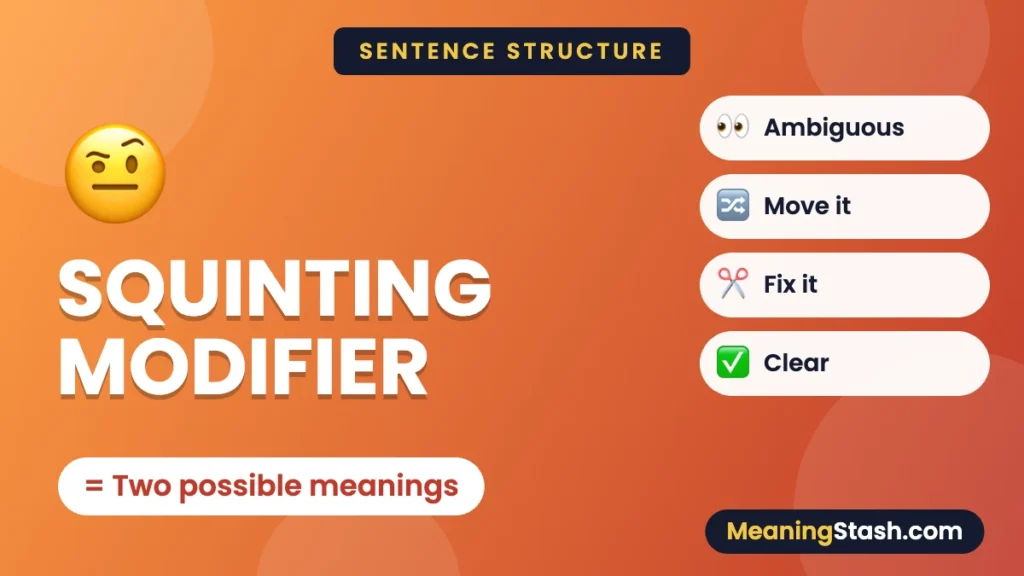
A squinting modifier can describe either the words before it or the words after it. Its position leaves the reader with two possible meanings. To fix it, decide what you mean and move or rewrite the description so that only that meaning remains.
For example, “I told Lina on Tuesday I would call” can place either the telling or the call on Tuesday. Punctuation alone is not always enough; a clear rewrite is usually safer.
Squinting modifier examples with both meanings
1. “People who practise regularly improve.”
Regularly could describe the practice or the improvement. If you mean regular practice, write “People who practise on a regular schedule improve.” If you mean regular improvement, write “People who practise show regular improvement.” The first describes a habit; the second describes a result.
2. “I told Lina on Tuesday I would call.”
If the conversation happened on Tuesday: “On Tuesday, I told Lina I would call.” If the call is planned for Tuesday: “I told Lina I would call on Tuesday.” Moving the time phrase makes the intended event clear.
3. “The manager said after lunch we could leave.”
If the manager spoke after lunch: “After lunch, the manager said we could leave.” If lunch sets the departure time: “The manager said we could leave once lunch was over.”
4. “The coach explained before practice we should rest.”
If the explanation happened first: “Before practice, the coach explained that we should rest.” If the rest must happen first: “The coach explained that we should rest before practice.” Adding that can help show the clause boundary.
5. “The changes we discussed recently caused confusion.”
If the discussion was recent: “The changes from our recent discussion caused confusion.” If the confusion is recent: “The changes we discussed have caused confusion recently.” Choose the rewrite that matches the timeline.
Why position matters
A modifier adds information about another word or phrase. Time expressions and adverbs can easily sit between two possible targets. The sentence may be grammatically complete while still making the reader stop and guess.
Not every adverb in the middle of a sentence is an error. Ask whether a reasonable reader could genuinely attach it in two ways. If context already makes the meaning clear, the sentence may not need a heavy rewrite.
How to fix a squinting modifier
- Identify the describing words. Look for words such as often, recently or a time phrase such as after lunch.
- Name both possible targets. Does the phrase describe the first action or the next one?
- Choose your intended meaning. A correction should preserve your message, not invent a different one.
- Move or expand the phrase. Use a clearer clause, a specific date or two shorter sentences.
- Read the rewrite without the original. The reader should no longer need the explanation.
Do not assume that inserting a comma always solves the problem. Commas can help mark a boundary, but the wording must still show which action the phrase describes.
Squinting, misplaced and dangling modifiers
| Type | Main problem |
|---|---|
| Squinting | A description can point in two directions. |
| Misplaced | A description sits near the wrong word. |
| Dangling | The intended person or thing is missing or does not match the sentence’s subject. |
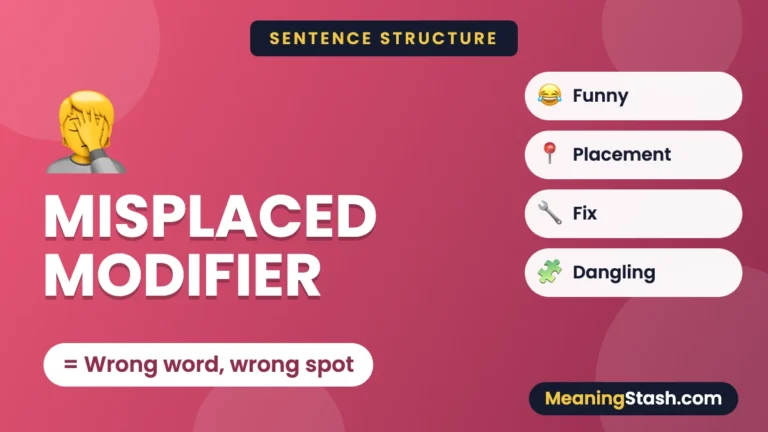
Misplaced modifier examples show how moving a description can attach it to the right noun. A dangling opening such as “Walking home, the rain began” needs a person doing the walking, not simply a different comma.
These distinctions are part of clear modifier placement. If a deadline is involved, an exact time can also prevent the uncertainty behind EOD in work messages.
Frequently asked questions
What is another name for a squinting modifier?
It is sometimes called a two-way modifier because it can appear to describe material on either side.
Is a squinting modifier always one word?
No. A phrase such as “after lunch” can also have an unclear attachment.
Can adding that fix the sentence?
Sometimes. That can show where a reported clause begins, but check that the description still attaches to the intended action.
Can one unclear sentence have two correct rewrites?
Yes. Each rewrite can express a different meaning. Choose the one that matches what the writer intended.