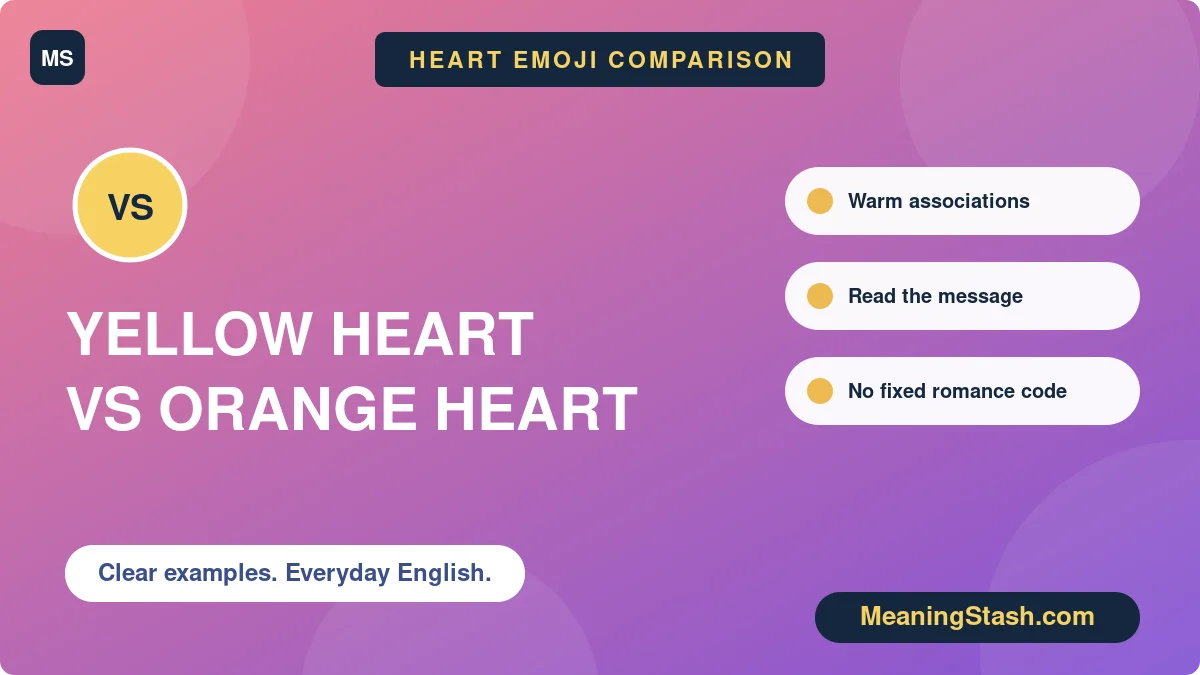
💛 Yellow heart vs 🧡 orange heart meaning is a comparison of common associations, not a fixed relationship code. The 💛 yellow heart often suggests friendliness, happiness or encouragement. The 🧡 orange heart often suggests warmth or affection. Either can also match a favorite color, photo or visual theme.
You cannot reliably decide whether someone is flirting, setting a boundary or changing their feelings from these colors alone.
💛 Yellow heart vs 🧡 orange heart meaning at a glance
| Emoji and name | Possible associations | Example |
|---|---|---|
| 💛 Yellow heart | Joy, friendship, encouragement or a yellow theme. | “You did brilliantly today 💛 Yellow Heart” |
| 🧡 Orange heart | Warmth, affection or an orange theme. | “Thanks for making me feel welcome 🧡 Orange Heart” |
The same sentence can work with either heart. Color gives a possible tone cue; the words explain the message.
What a 💛 yellow heart can communicate
A 💛 yellow heart can reinforce a cheerful thank-you, congratulations or friendly encouragement. It may also accompany yellow flowers, a team color or a sunny photograph.
“Proud of you 💛 Yellow Heart” is encouraging because of the sentence as well as the heart. It does not become exclusively platonic because the heart is yellow. The broader heart emoji color meanings overlap in real conversations.
What an 🧡 orange heart can communicate
An 🧡 orange heart can add warm appreciation or affection: “I’m glad we caught up 🧡 Orange Heart.” It may also be chosen for autumn colors, a brand or a personal preference.
Claims that orange always means “more than a friend but less than a partner” are too rigid. Some people use orange with a partner; others use it with friends or family. Ask about the relationship when that question matters.
Compare the message, not just the color
“Thanks for the ride 💛 Yellow Heart” and “Thanks for the ride 🧡 Orange Heart” both express gratitude. “Would you like to go on a date? 💛 Yellow Heart” is a romantic invitation because it explicitly says so.
If someone changes colors, ordinary explanations include matching a photo, choosing a different aesthetic or tapping a frequently used symbol. A change is not reliable evidence of a change in commitment.
How to reply
- After congratulations: “Thank you! Your support helped.”
- After a favor: “You’re welcome. I’m glad I could help.”
- After a warm invitation: Answer the invitation directly.
- If the intention is unclear: Ask a short question instead of comparing emoji colors.
A 🫶 heart hands reply can add warmth if it fits your style. You do not have to match the sender’s color, and choosing a different one is not inherently rude.
Typed hearts and app-assigned badges
A heart someone types into a message is chosen by that person. A badge assigned by an app can follow that app’s feature rules. Do not assume the two have identical meanings; consult the app’s current explanation if it is a badge rather than message text.
Make important feelings readable
Write “Thank you for being there” or “I care about you” when the feeling matters. As with the 🤍 white heart meaning, a supportive sentence is clearer than expecting a small colored shape to communicate everything.
Frequently asked questions
Is a 💛 yellow heart always friendship only?
No. Friendship is a common association, but the symbol is used in many relationships and contexts.
Does an 🧡 orange heart mean a crush?
It can accompany a flirty message, but the color alone does not establish that meaning.
Is orange more romantic than yellow?
There is no universal romance scale for heart colors.
Should I worry if someone changes heart colors?
A color change alone is not a reliable signal of relationship trouble. Look at the actual conversation and behavior.