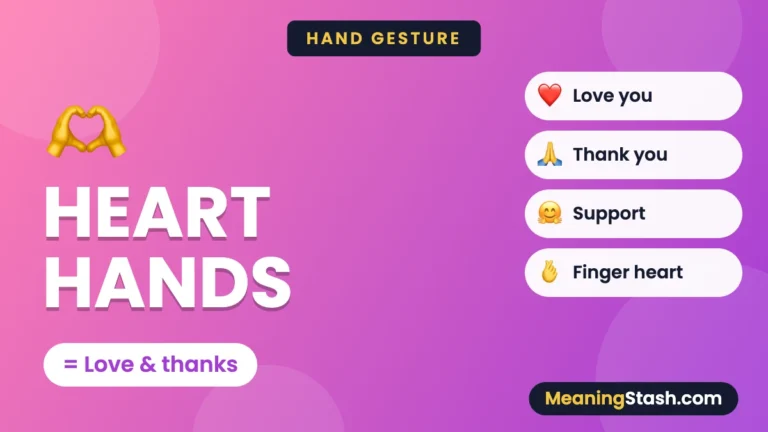
🫶 Heart hands vs 🫰 finger heart emoji compares two different gestures that can express affection. The 🫶 heart hands emoji uses two hands to form a heart outline. The 🫰 Finger Heart emoji shows an index finger and thumb crossed and is often used as a small 🫰 finger heart.
Both can accompany thanks, support, friendship or romance. The hand shape alone does not tell you what relationship the sender wants.
🫶 Heart hands vs 🫰 finger heart emoji at a glance
| Emoji and readable name | Visible shape | Common affectionate use |
|---|---|---|
| 🫶 Heart hands | Two hands making a heart. | “Thank you for being there 🫶 Heart Hands” |
| 🫰 Hand with index finger and thumb crossed | A crossed finger-and-thumb gesture. | “Sending love 🫰 Finger Heart” |
“🫰 Finger heart” is a common description of the affectionate use. The longer character name describes its shape without claiming that every use is a heart.
When 🫶 heart hands feels natural
The 🫶 heart hands meaning often involves appreciation or support. A creator may thank an audience, a friend may acknowledge help or a partner may express affection. The same symbol can fit all three.
For example, “Thanks to everyone who volunteered 🫶 Heart Hands” addresses a group. It is not a romantic message to every reader. The written sentence establishes the purpose.
When the 🫰 finger heart appears
The crossed finger-and-thumb gesture is widely recognized in affectionate fan and social contexts, including Korean popular-culture settings. It can add a playful “love” or appreciation gesture to a short message.
Its shape can also be interpreted differently in another context, including money-related or other gestures. Do not assume the affectionate reading if the actual words concern price, cost or a different cultural use.
Do they mean different levels of love?
There is no universal intensity scale. A large two-handed shape is not proof of stronger feelings, and a small 🫰 finger heart is not proof of a casual relationship.
The same caution applies to heart emoji colors. People choose symbols for habit, appearance, community conventions or convenience. Meaning comes from the wider exchange.
How to reply
- A thank-you: “You’re welcome. I’m glad I could help.”
- Encouragement: “Thank you—I needed that today.”
- Affection from someone close: Reply in the words or symbols that suit your relationship.
- An unclear gesture: Ask what the sender meant if the distinction matters.
You may return either symbol, a different heart or no emoji at all. A reply does not have to mirror the sender’s hand shape or skin-tone choice.
Do not confuse these with other finger emoji
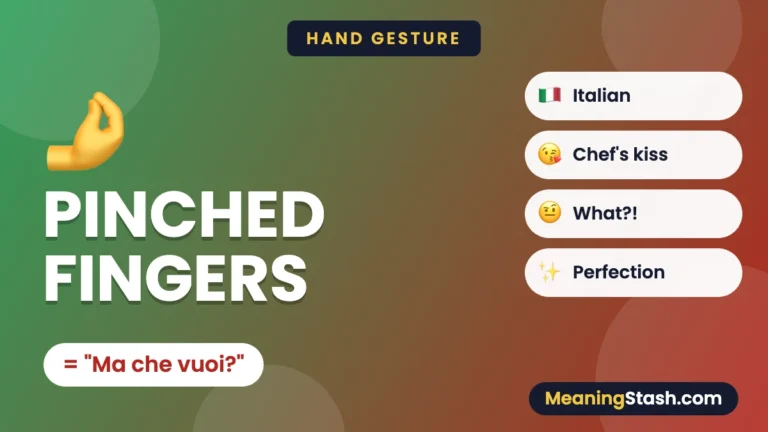
The 🤌 pinched fingers gesture gathers fingertips together and may convey questioning or praise. The 🤏 pinching hand leaves a small gap and can suggest a small amount. Neither should be automatically labeled a 🫰 finger heart.
In an explanation, write the name beside the symbol. This helps readers using small screens, different designs or devices that cannot display a newer character.
Using words alongside the gesture
“I appreciate your support” communicates the message even if the emoji fails to display. For alternatives, words related to appreciation distinguish gratitude from admiration. Choose the word for the actual feeling rather than making the gesture carry everything.
Frequently asked questions
Is 🫰 finger heart the official character name?
The character is named 🫰 hand with index finger and thumb crossed. 🫰 Finger heart describes a common affectionate use.
Are 🫶 heart hands always romantic?
No. Friendship, gratitude, family affection and community support are common contexts.
Does the 🫰 finger heart always mean love?
No. The gesture can be read differently depending on the words and cultural context.
Do skin-tone options change the basic gesture?
They change the displayed appearance of the hands, not the basic shape. Do not infer a sender’s identity or intentions from the option alone.